An official website of the United States government





New Aerosol Optical Depth Data Available for SGP and NSA
Published: 9 February 2026
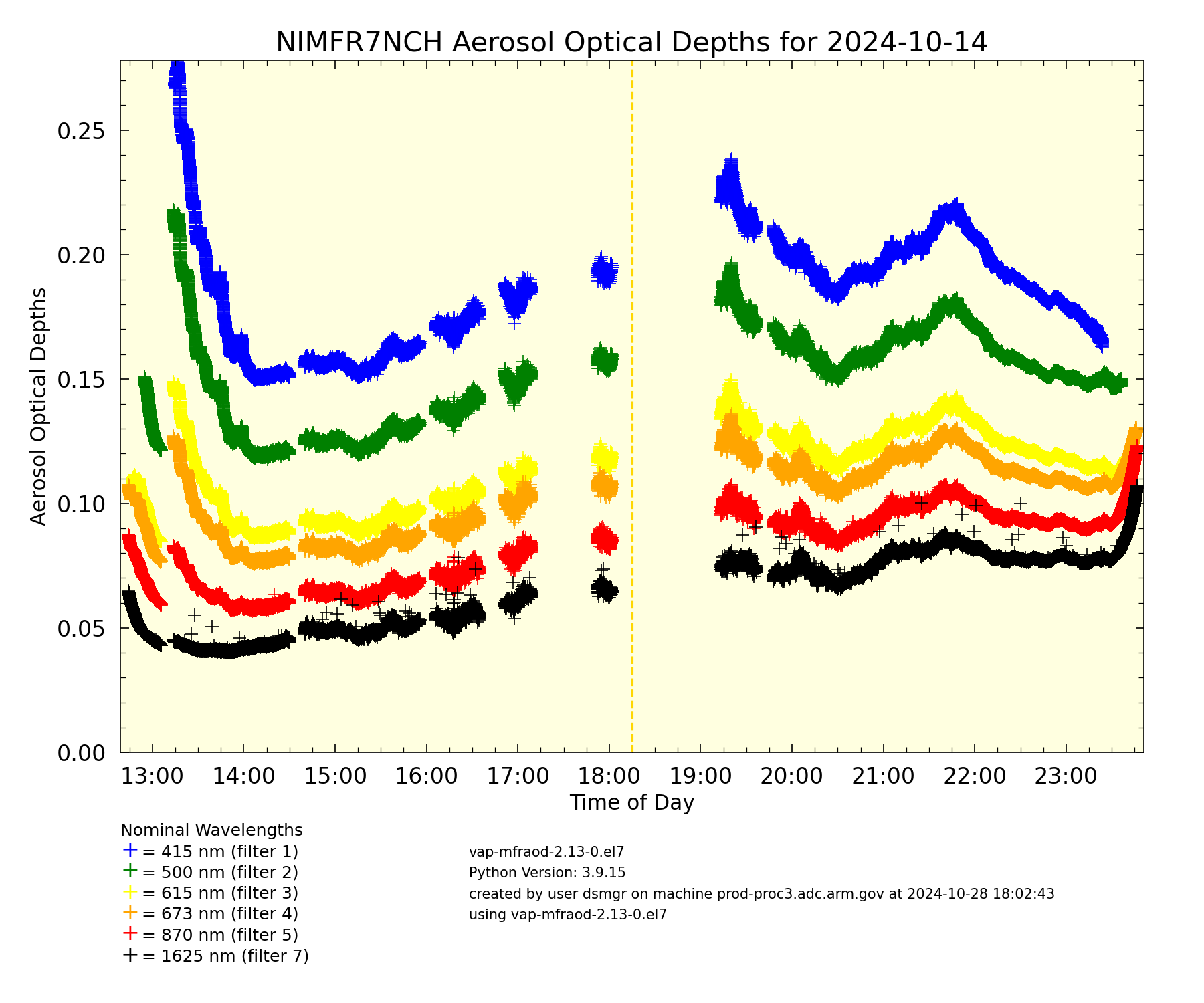
The Aerosol Optical Depth (AOD) value-added product derived from 7-channel normal incidence multifilter radiometer (NIMFR) measurements is now available for the Southern Great Plains (SGP) and North Slope of Alaska (NSA) atmospheric observatories.
AOD is the measure of the total aerosol burden in a vertical column of the atmosphere. The value-added product, known as AOD-NIMFR, reports cloud-screened AOD from the direct normal irradiance measured by NIMFRs at the Atmospheric Radiation Measurement (ARM) User Facility’s ground-based sites.
AODs are calculated at wavelengths of 415, 500, 615, 673, 870, and 1625 nanometers (nm). The 940 nm channel is used to retrieve columnar abundances of water vapor.
ARM finished adding the near-infrared 1625 nm channel to its NIMFRs and other ground-based shortwave spectral instruments in fiscal year 2021. The longer wavelength allows for improved retrievals of aerosol and cloud properties. For example, it helps constrain the size distribution of large aerosol particles, resulting in more accurate retrievals of aerosol optical properties.
Scientists use AOD measurements to evaluate aerosol radiative forcing in earth system models. Because AOD is a measure of the aerosol burden in the atmosphere, AOD-NIMFR also allows a user to analyze variability of aerosol loading.
More information about the product can be found on the AOD-NIMFR web page.
AOD-NIMFR 7-channel production data are available for the SGP Central Facility near Lamont, Oklahoma, from September 23, 2021, through June 8, 2025. Production data are also available for the NSA central facility at Utqiaġvik (formerly Barrow), Alaska, from June 16, 2021, through June 8, 2025. The daily files for both sites are in netCDF format. NSA and SGP data beyond June 8, 2025, are planned to be available later in 2026.
Access the AOD-NIMFR 7-channel data in the ARM Data Center. (To download the data, first create an ARM account.)
For questions or to report data issues, please contact ARM translator John Shilling or developers Erol Cromwell and Krista Gaustad.
Data can be referenced as doi:10.5439/1879865.

Follow Us:






Keep up with the Atmospheric Observer
Updates on ARM news, events, and opportunities delivered to your inbox
ARM User Profile
ARM welcomes users from all institutions and nations. A free ARM user account is needed to access ARM data.