An official website of the United States government





Gridded Scanning Cloud Radar Data Produced for BNF Observatory
Published: 19 September 2025
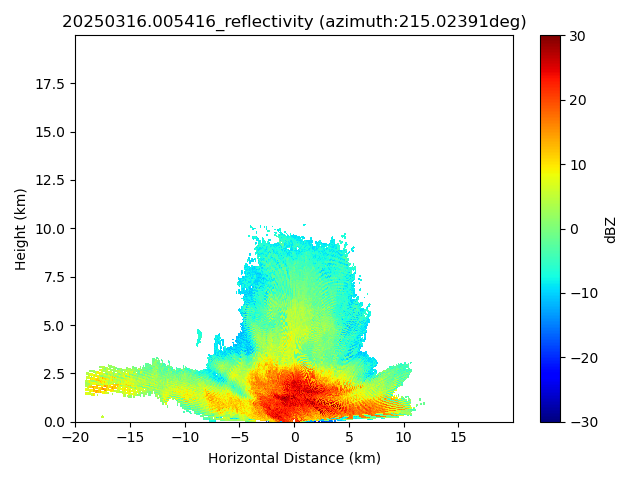
The Atmospheric Radiation Measurement (ARM) User Facility released a set of four cloud radar value-added products (VAPs) for the Bankhead National Forest (BNF) atmospheric observatory in northern Alabama.
Scanning ARM Cloud Radar Grid (SACRGRID) VAPs provide radar moments and derived quantities from scanning cloud radars on a Cartesian grid, making the radar observations easier for scientists to use for analyses of clouds. The latest SACRGRID releases consist of gridded range-height indicator (RHI) and plan position indicator (PPI) scans from the Ka-Band Scanning ARM Cloud Radar (KASACR) and X-Band Scanning ARM Cloud Radar (XSACR).
All four VAPs, which are available in evaluation mode, use a1-level uncalibrated radar data as input. The gridded radar products include reflectivity, mean Doppler velocity, spectral width, signal-to-noise ratio, differential phase, and copolar correlation coefficient.
The KASACRGRIDRHI and XSACRGRIDRHI VAPs remap RHI-type scans onto a Cartesian grid. At the BNF, ARM uses the Hemispheric Sky RHI (HSRHI) scan strategy, mostly consisting of consecutive horizon-to-vertical scans (elevation angles from 0 to 180 degrees) at azimuths of 35 and 215 degrees. On some days early in the deployment, scans occurred at azimuths of 24, 40, 56, and 203 degrees.
Input data for both VAPs are a1-level uncalibrated HSRHI data. Gridding is performed using a nearest neighbor algorithm, with a censor mask applied to identify significant echoes, such as clutter, clouds, and precipitation. Gaseous attenuation correction is applied to the KASACR data before gridding to eliminate water vapor as a source of signal attenuation.
The output is a single c0-level netCDF file with uncalibrated radar Doppler moments remapped onto a two-dimensional (2D) Cartesian grid.
The KASACRGRIDPPI and XSACRGRIDPPI VAPs remap PPI-type scans onto a Cartesian grid. The PPI scan strategy at the BNF uses consecutive 360-degree surveillance scans, which consists of multiple elevation angles from 2 to 17 degrees.
Input data for both VAPs are a1-level uncalibrated PPI data. The gridding process is done in a similar way as for KASACRGRIDRHI and XSACRGRIDRHI.
The output data are uncalibrated c0-level netCDF files, each comprising gridded observations for a single azimuthal sweep while maintaining a fixed elevation angle. Surveillance scans are gridded for elevations of 2 and 17 degrees. Output variables include the uncalibrated radar moments remapped onto a 2D Cartesian grid.
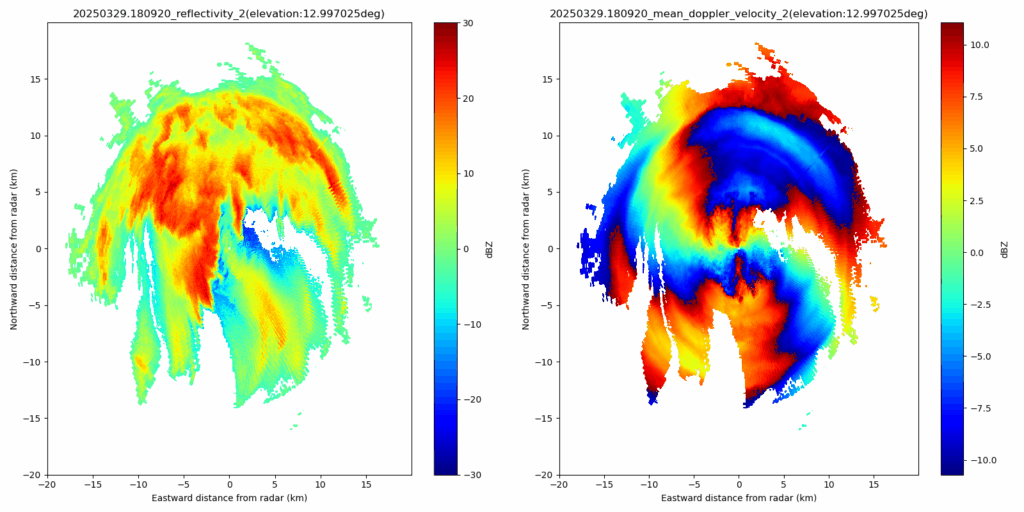
Evaluation data from all four VAPs are currently available from November 2024 through June 2025 for the BNF KASACR/XSACR deployment. The radars are located outside the forest at supplemental site S4, 16.4 kilometers away from the BNF’s main site.
The next set of c0-level data is scheduled to be processed at the beginning of October 2025. Please note that c0-level data from the SACRGRID VAPs should be considered preliminary. Calibrated b1-level KASACR and XSACR data are expected to be ready around November 2025. Once these new input data are available, the c0-level SACRGRID data will be processed to c1.
Scientists can access the data and additional information about the VAPs on the web pages for KASACRGRIDRHI, KASACRGRIDPPI, XSACRGRIDRHI, and XSACRGRIDPPI. (To download the data, first create an ARM account.)
Users are encouraged to provide feedback on the quality and accuracy of these evaluation data before the SACRGRID VAPs move into production mode. To give feedback or ask questions about the data, please contact VAP developer Meng Wang or ARM interim translator Scott Giangrande.
To cite the data, please use the following DOIs:
- KASACRGRIDRHI – doi:10.5439/1578283
- KASACRGRIDPPI – doi:10.5439/1768878
- XSACRGRIDRHI – doi:10.5439/1578281
- XSACRGRIDPPI – doi:10.5439/2000080.

Follow Us:






Keep up with the Atmospheric Observer
Updates on ARM news, events, and opportunities delivered to your inbox
ARM User Profile
ARM welcomes users from all institutions and nations. A free ARM user account is needed to access ARM data.