An official website of the United States government





First Characterized, Corrected Data Available From Fixed-Site KAZRs
Published: 20 November 2025
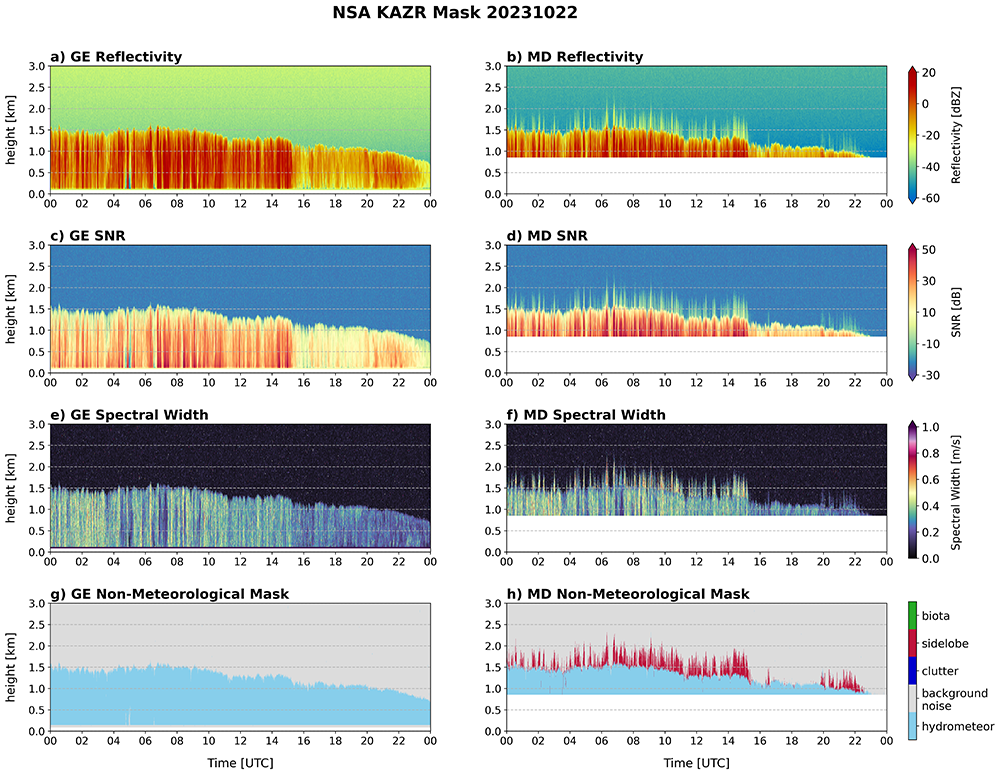
The Atmospheric Radiation Measurement (ARM) User Facility has released its first set of characterized and corrected Ka-Band ARM Zenith Radar (KAZR) data from the Eastern North Atlantic (ENA), North Slope of Alaska (NSA), and Southern Great Plains (SGP) fixed-location atmospheric observatories. These KAZR data span a five-year period (2020–2024) and are b1-level, meaning they underwent calibration, correction, and quality control processes beyond ARM’s standard quality checks and corrections.
ARM’s fixed sites produce long-term data sets that can be used to improve understanding of atmospheric processes across various environments. The vertically pointing KAZR is a key ARM remote sensing instrument that can be used to investigate cloud and precipitation properties.
ARM staff completed two main tasks to produce the quality-controlled b1-level data from the fixed-site KAZRs. They cross-compared a1-level data from each KAZR with data from other ARM instruments and nearby radars to determine the KAZR reflectivity offsets. They also developed meteorological echo masks, which allow scientists to quickly remove background noise and clutter, including contaminated gates from insects (prevalent at the SGP) and sidelobes (prevalent at the NSA).
While the NSA and SGP both have first-generation KAZRs, the ENA has a second-generation KAZR (KAZR2). The KAZR2 has a different transmitter from the first-generation KAZR and operates with three modes instead of two.

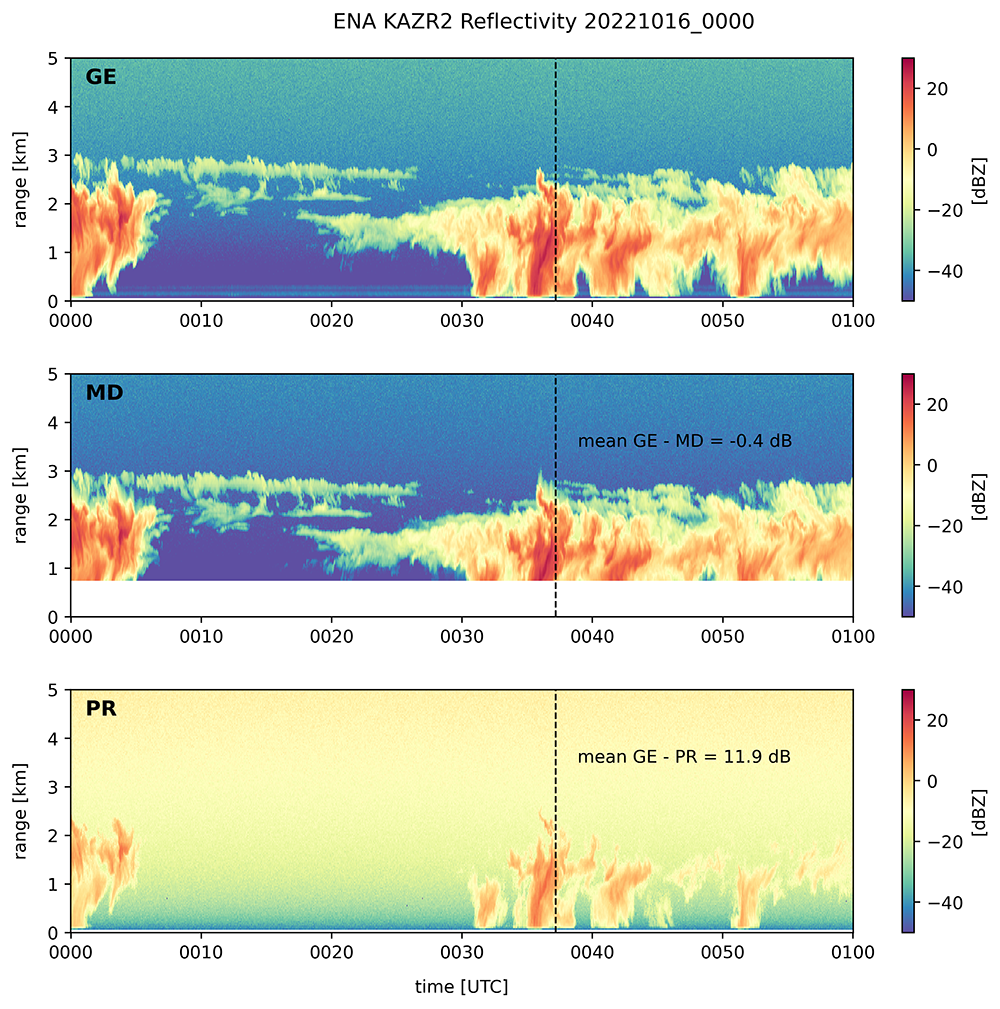
The corrected and characterized 2020–2024 data are available now in CfRadial format for the KAZR general sensitivity (GE) and moderate sensitivity (MD) modes at the NSA and SGP, and for the KAZR2 GE, MD, and precipitation sensitivity (PR) modes at the ENA.
More information about the data, including the radar analysis and mask development, can be found in the fixed-site KAZR b1-level data processing technical report.
Currently, ARM plans to release KAZR/KAZR2 b1-level data from the fixed sites every year for the previous year. More information is available in the latest ARM radar plan.
Access the KAZR GE and MD b1-level data and the KAZR2 GE, MD, and PR b1-level data in the ARM Data Center. (To download the data, first create an ARM account.)
For questions or to report data issues, please contact the ARM radar team.
To cite the NSA and SGP KAZR data, please use doi:10.5439/1615726 for GE mode and doi:10.5439/1615486 for MD mode.
To cite the ENA KAZR2 data, please use doi:10.5439/2589318 for GE mode, doi:10.5439/2589319 for MD mode, and doi:10.5439/2589320 for PR mode.

Follow Us:






Keep up with the Atmospheric Observer
Updates on ARM news, events, and opportunities delivered to your inbox
ARM User Profile
ARM welcomes users from all institutions and nations. A free ARM user account is needed to access ARM data.