An official website of the United States government





Synoptic Weather Regime Classification Product Now Available for CoURAGE Campaign
Published: 25 February 2026
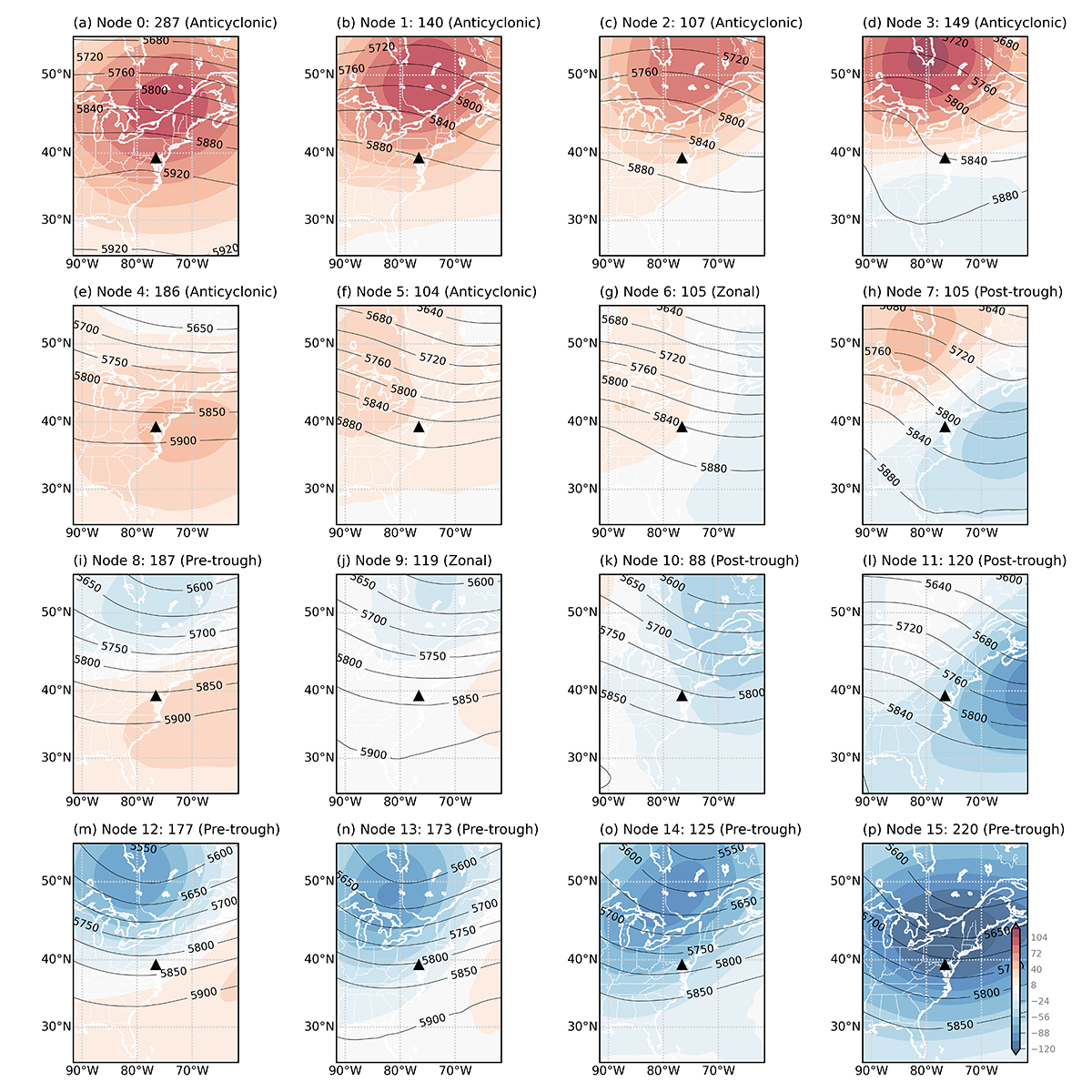
The Atmospheric Radiation Measurement (ARM) User Facility has released the Synoptic Weather Regime Classification (SynopWeaReg) machine learning value-added product (VAP) for the 2024–2025 Coast-Urban-Rural Atmospheric Gradient Experiment (CoURAGE) in the Baltimore, Maryland, area.
Currently in evaluation mode, this VAP provides key insights into the variability of large-scale circulations over an ARM site. It helps reveal how these weather patterns influence cloud formation, aerosol transport, and other atmospheric features over the area and provides broader context for the ARM site observations. The product also assists researchers in identifying specific weather regimes for their studies, such as selecting cases of interest and examining multiple cases under similar large-scale conditions, which can be useful for model evaluation and parameterization development.
This approach provides an avenue to constrain the effects of large-scale weather conditions on atmospheric processes of interest, including their impacts on aerosol-cloud-precipitation relationships.
To classify the dominant synoptic weather regimes in the Baltimore region, ARM staff applied a self-organizing map (SOM), an unsupervised machine learning approach, to 26 years of European Centre for Medium-Range Weather Forecasts Reanalysis version 5 (ERA5) data. These training data included daily 500 hPa geopotential height anomalies—geopotential heights minus the mean state values during the training data period—at 05:00 Coordinated Universal Time (UTC) over the Baltimore region (24.3°N, 54.3°N, 91.6°W, 61.6°W).
The data analysis distinguished four synoptic regimes: pre-trough, post-trough, anticyclonic, and zonal regimes.
The SynopWeaReg VAP provides a single file for each season during CoURAGE, with the domain centered over the field campaign’s main instrument site in Baltimore. The VAP output identifies the dominant weather regime and SOM node for each day of the season. SOM nodes are categories produced by the SOM method.
CoURAGE SynopWeaReg data are available in the ARM Data Center as follows:
- Winter (December 1, 2024, through February 28, 2025), listed as the synopwearegdjf2025ml data product
- Spring (March 1 through May 31, 2025), listed as synopwearegmam2025ml
- Summer (June 1 through August 31, 2025), listed as synopwearegjja2025ml
- Fall (September 1 through November 30, 2025), listed as synopwearegson2025ml.
This VAP is planned to cover all ARM sites in the future.
More information about the VAP can be found on the SynopWeaReg web page.
Access the SynopWeaReg data in the ARM Data Center. (To download the data, first create an ARM account.)
To ask questions, provide feedback, or report data issues before this evaluation VAP moves to production, please contact SynopWeaReg translator Min Deng or VAP developer Aifang Zhou.
To cite the SynopWeaReg data products, please use the following DOIs:
- Winter product (synopwearegdjf2025ml) – doi:10.5439/2998553
- Spring product (synopwearegmam2025ml) – doi:10.5439/2572131
- Summer product (synopwearegjja2025ml) – doi:10.5439/2997935
- Fall product (synopwearegson2025ml) – doi:10.5439/3000237.

Follow Us:






Keep up with the Atmospheric Observer
Updates on ARM news, events, and opportunities delivered to your inbox
ARM User Profile
ARM welcomes users from all institutions and nations. A free ARM user account is needed to access ARM data.