An official website of the United States government





Characterized and Calibrated KAZR Data Now Available for CoURAGE Campaign
Published: 6 July 2026
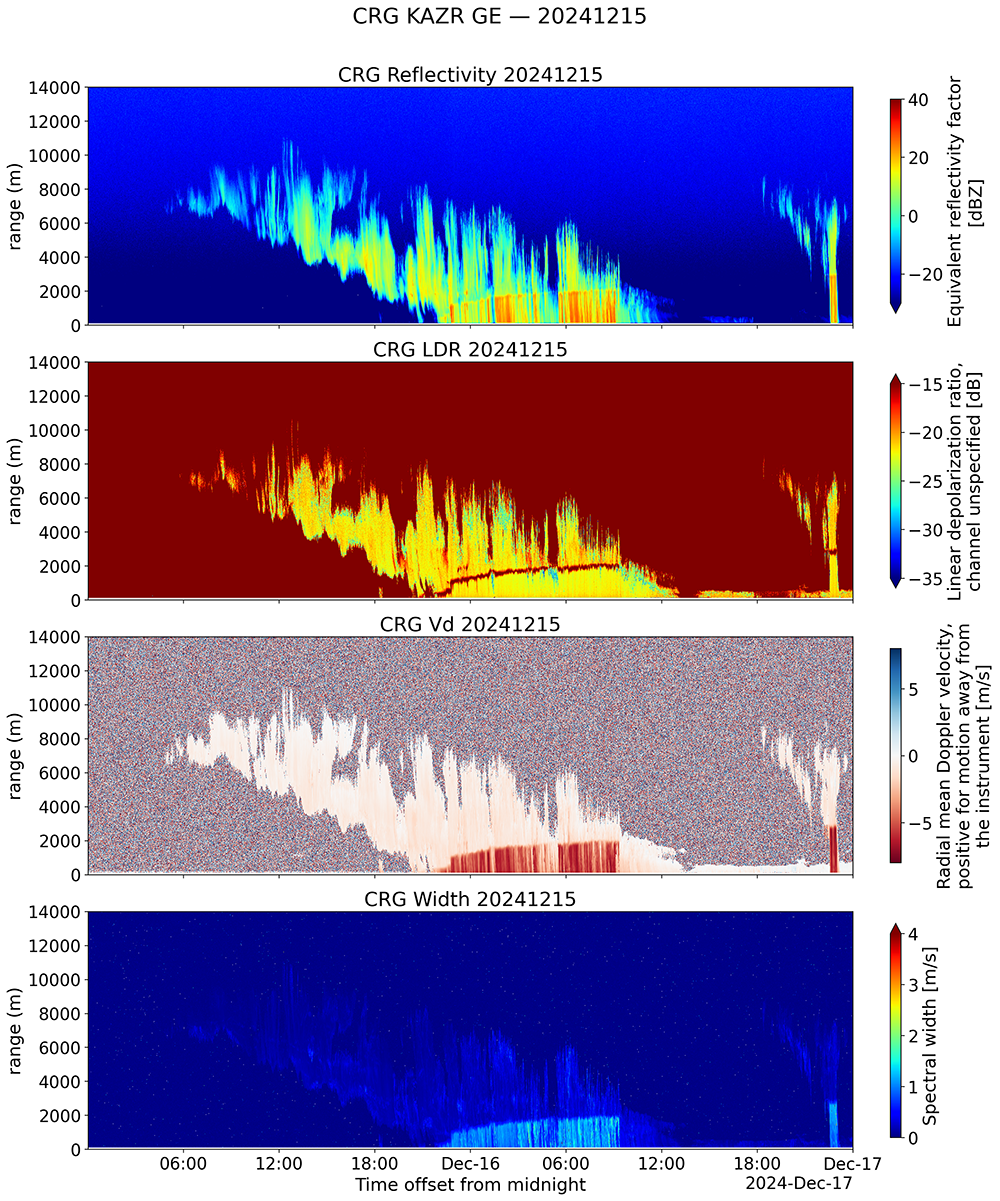
The Atmospheric Radiation Measurement (ARM) User Facility has released characterized and corrected Ka-Band ARM Zenith Radar (KAZR) data from the 2024–2025 Coast-Urban-Rural Atmospheric Gradient Experiment (CoURAGE) in Baltimore, Maryland. These KAZR data are b1-level, meaning they underwent calibration, correction, and quality control processes beyond ARM’s standard quality checks and corrections.
The CoURAGE deployment focused on characterizing atmospheric structure, cloud properties, and precipitation processes across strong land-use and surface heterogeneity gradients associated with urban, rural, and coastal (Chesapeake Bay) environments.
To produce the quality-controlled b1-level data, ARM staff applied reflectivity offsets and meteorological echo masks to the KAZR a1-level data. The meteorological echo masks allow scientists to quickly remove background noise and clutter when needed.
The corrected and characterized KAZR data are available now in CfRadial format for the radar’s two operating modes, general sensitivity (GE) and moderate sensitivity (MD).
More information about the data can be found in the CoURAGE KAZR b1-level data processing technical report.
Access the KAZR GE and MD b1-level data in the ARM Data Center. (To download the data, first create an ARM account.)
For questions or to report data issues, please contact the ARM radar team.
To cite the data, please use doi:10.5439/1615726 for GE mode and doi:10.5439/1615486 for MD mode.

Follow Us:






Keep up with the Atmospheric Observer
Updates on ARM news, events, and opportunities delivered to your inbox
ARM User Profile
ARM welcomes users from all institutions and nations. A free ARM user account is needed to access ARM data.