An official website of the United States government





New Southern Great Plains Continuous Large-Scale Forcing Data Released
Published: 13 July 2026
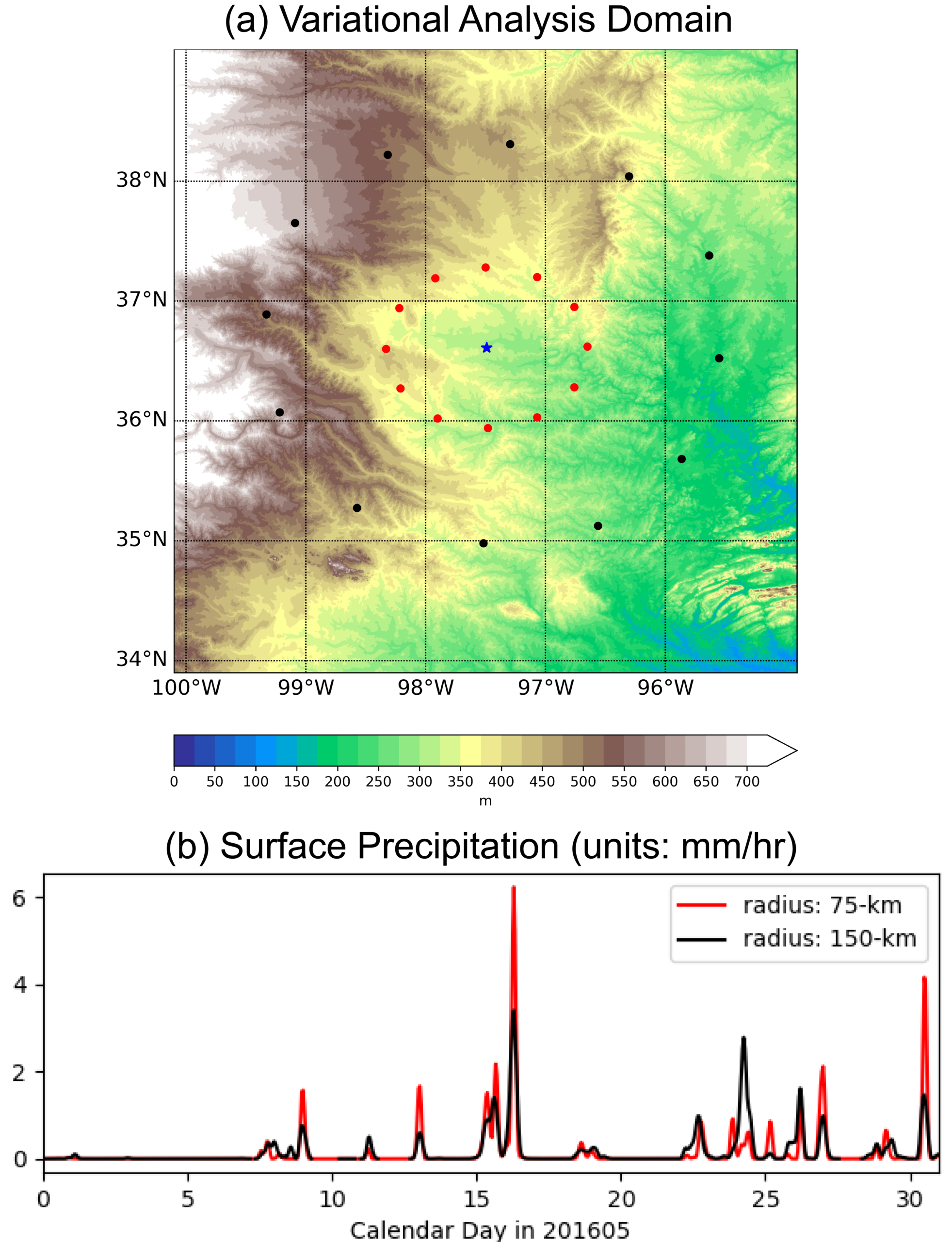
A new release of continuous large-scale forcing data for the Atmospheric Radiation Measurement (ARM) User Facility’s Southern Great Plains (SGP) atmospheric observatory is now available. The continuous large-scale forcing value-added product (VAP), known as VARANAL, was developed from a constrained variational analysis approach documented in Zhang and Lin (1997) and Zhang et al. (2001).
The VARANAL VAP includes both the large-scale forcing terms and the evaluation fields. These can be used for driving single-column models, cloud-resolving models, or large-eddy simulations (LES), including those from the LES ARM Symbiotic Simulation and Observation (LASSO) activity, and for validating model simulations.
This evaluation release covers 15 years of data (2004–2018). In this new release, a smaller variational analysis domain (75-kilometer radius) has been applied with settings identical to those in previously released SGP VARANAL version 2 data to meet various process modeling needs as earth system model resolutions continue to increase. The previously released version 2 domain had a radius of 150 kilometers.
The new forcing data follow the resolution of the previously released version 2 data, with one-hour time resolution and 25-hPa vertical resolution. The data are in netCDF format.
Scientists can begin using the new SGP VARANAL data for model simulation and evaluation.
Data from January 1, 2004, to April 30, 2012, use combined Rapid Update Cycle (RUC) and constrained variational analyses at 60-minute time resolution and are labeled by ARM as 60varanaruc75km. Data from May 1, 2012, to December 31, 2018, use combined Rapid Refresh (RAP) and constrained variational analyses, also at 60-minute time resolution, and are labeled by ARM as 60varanarap75km.
Access the data in the ARM Data Center. (To download the data, first create an ARM account.)
For questions, feedback, or to report data issues, please contact VAP developer Cheng Tao or ARM translator Shaocheng Xie. More details about the ARM continuous forcing data are in Xie et al. (2004) and Tang et al. (2019).
Data can be referenced as doi:10.5439/2377035 for the 60-minute RAP VARANAL product (60varanarap75km.c1) and doi:10.5439/2377036 for the 60-minute RUC VARANAL product (60varanaruc75km.c1).
References:
Zhang M and J Lin. 1997. “Constrained Variational Analysis of Sounding Data Based on Column-Integrated Budgets of Mass, Heat, Moisture, and Momentum: Approach and Application to ARM Measurements.” Journal of the Atmospheric Sciences, 54(11):1503-1524, https://doi.org/10.1175/1520-0469(1997)054<1503:CVAOSD>2.0.CO;2
Zhang M, J Lin, RT Cederwall, JJ Yio, and SC Xie. 2001. “Objective Analysis of ARM IOP Data: Method and Sensitivity.” Monthly Weather Review, 129(2):295-311, https://doi.org/10.1175/1520-0493(2001)129<0295:OAOAID>2.0.CO;2
Xie S, RT Cederwall, and MH Zhang. 2004. “Developing long-term single-column model/cloud system–resolving model forcing data using numerical weather prediction products constrained by surface and top of the atmosphere observations.” Journal of Geophysical Research: Atmospheres, 109(D1):D01104, https://doi.org/10.1029/2003JD004045
Tang S, C Tao, S Xie, and M Zhang. 2019. Description of the ARM Large-Scale Forcing Data from the Constrained Variational Analysis (VARANAL) Version 2. Ed. by Robert Stafford, ARM. DOE/SC-ARM-TR-222, https://doi.org/10.2172/1808705

Follow Us:






Keep up with the Atmospheric Observer
Updates on ARM news, events, and opportunities delivered to your inbox
ARM User Profile
ARM welcomes users from all institutions and nations. A free ARM user account is needed to access ARM data.