An official website of the United States government





New EPCAPE VARANAL Forcing Data Released to Evaluation
Published: 30 July 2026
A new version of continuous large-scale forcing data for the 2023–2024 Eastern Pacific Cloud Aerosol Precipitation Experiment (EPCAPE) is now available from the Atmospheric Radiation Measurement (ARM) User Facility.
The forcing data for the EPCAPE field campaign in La Jolla, California, were produced using the constrained variational analysis approach described in Zhang and Lin (1997) and Zhang et al. (2001). This value-added product (VAP), known as VARANAL, can be used to drive single-column models, cloud-resolving models, and large-eddy simulation models for a variety of cloud and convective systems. To support model evaluation, VARANAL also provides diagnostic fields, including diabatic heating profiles, cloud fields, surface measurements, and large-scale environmental conditions.
Two versions of EPCAPE VARANAL forcing data were previously released: a standard product, which was derived using a pressure coordinate algorithm and assuming a flat surface to allow for easy defining of the model surface; and a sigma product, which was derived by applying a terrain-following sigma coordinate algorithm to better represent the effect of sloping terrain on the large-scale forcing fields (Tang et al. 2020). The new VARANAL product, known as version 1 (v1) of the sigma product, was also developed using European Centre for Medium-Range Weather Forecasts (ECMWF) Reanalysis version 5 (ERA5) data, but with an important update relative to the previously released EPCAPE sigma product (version 0, or v0).
In the new product, surface precipitation from a NOAA Multi-Radar/Multi-Sensor (MRMS) product was used as an additional constraint in the variational analysis, rather than relying solely on ERA5 precipitation. This improves consistency between the analyzed forcing fields and observed surface precipitation over the EPCAPE domain.
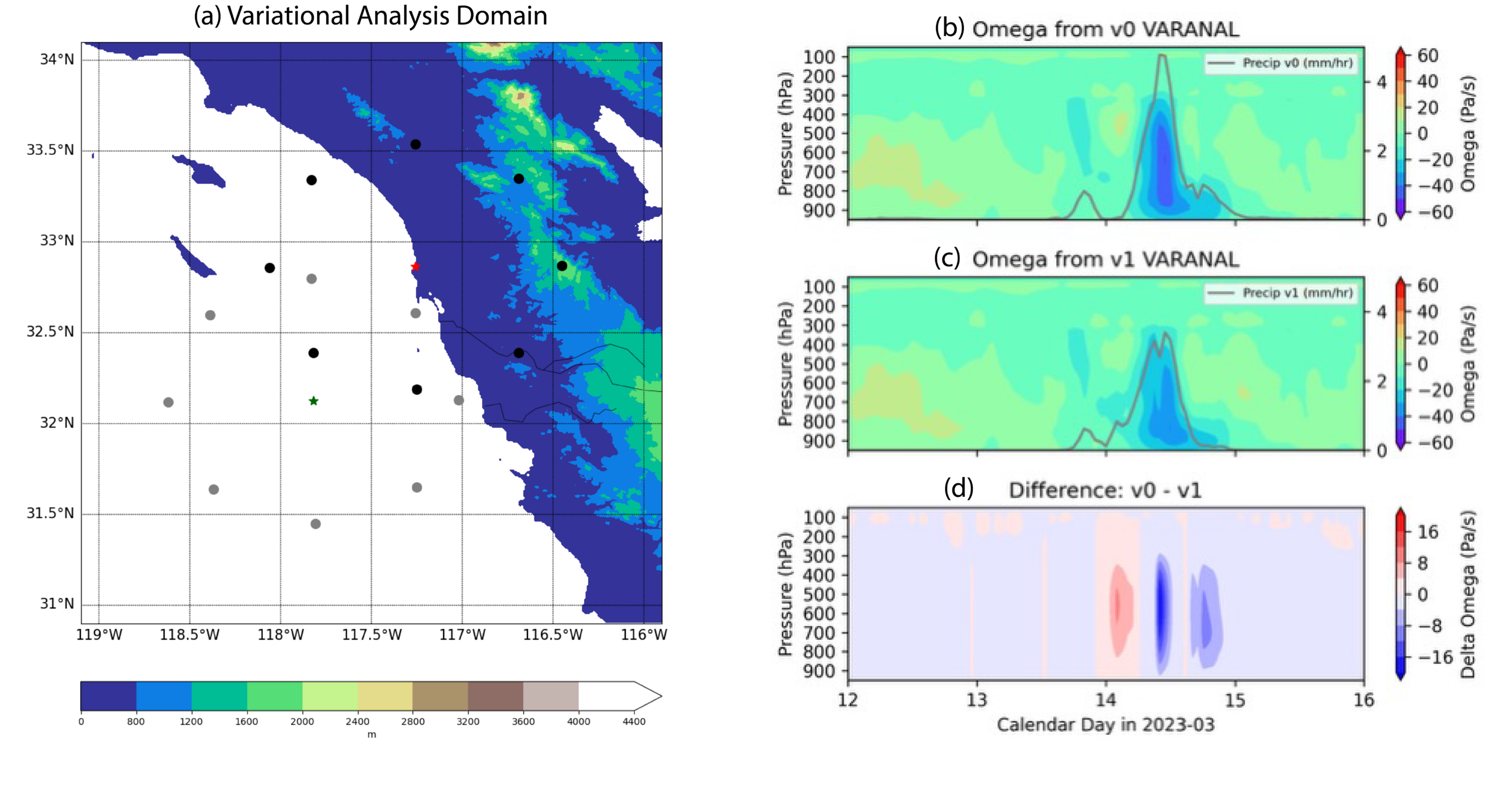
The variational analysis domain for the new product covers both ocean and land. The domain is centered on the ARM Mobile Facility site on the Ellen Browning Scripps Memorial Pier (117.26oW, 32.87oN) with a radius of 75 kilometers.
Like the first two VARANAL products released for EPCAPE, the new data set represents a spatial average over its analysis domain. Users need to be cautious when comparing the forcing data with ARM single-point measurements.
The EPCAPE VARANAL v1 sigma product (labeled by ARM as 60v1varanaecmwfsigma) is available in evaluation mode from March 1, 2023, through January 31, 2024. The data are in netCDF format, with a temporal resolution of 60 minutes and a vertical resolution of 25 hPa.
The standard EPCAPE VARANAL product (60varanaecmwf) and v0 sigma product (60varanaecmwfsigma) remain available in the ARM Data Center.
Users can access the v0 sigma product for consistency with prior simulations and v1 for analyses requiring the best available forcing quality.
Scientists can begin using the new EPCAPE large-scale variational analysis forcing data for model simulation and evaluation. Access the data in the ARM Data Center. (To download the data, first create an ARM account.)
More information about VARANAL can be found on the VAP web page. Additional details about ARM continuous forcing data are in Xie et al. (2004).
To ask questions, report data issues, or provide feedback on the new EPCAPE VARANAL v1 sigma product, please contact ARM VAP developer Cheng Tao or ARM translator Shaocheng Xie.
To cite the v1 data, please use doi:10.5439/2998914.
References:
Zhang M and J Lin. 1997. “Constrained Variational Analysis of Sounding Data Based on Column-Integrated Budgets of Mass, Heat, Moisture, and Momentum: Approach and Application to ARM Measurements.” Journal of the Atmospheric Sciences, 54(11):1503-1524, https://doi.org/10.1175/1520-0469(1997)054<1503:CVAOSD>2.0.CO;2
Zhang M, J Lin, RT Cederwall, JJ Yio, and SC Xie. 2001. “Objective Analysis of ARM IOP Data: Method and Sensitivity.” Monthly Weather Review, 129(2):295-311, https://doi.org/10.1175/1520-0493(2001)129<0295:OAOAID>2.0.CO;2
Xie S, RT Cederwall, and MH Zhang. 2004. “Developing long-term single-column model/cloud system–resolving model forcing data using numerical weather prediction products constrained by surface and top of the atmosphere observations.” Journal of Geophysical Research: Atmospheres, 109(D1):D01104, https://doi.org/10.1029/2003JD004045
Tang S, S Xie, M Zhang, and S Endo. 2020. “Improvement of Atmospheric Objective Analysis Over Sloping Terrain and Its Impact on Shallow-Cumulus Clouds in Large-Eddy Simulations.” Journal of Geophysical Research: Atmospheres, 125(13):e2020JD032492, https://doi.org/10.1029/2020JD032492

Follow Us:






Keep up with the Atmospheric Observer
Updates on ARM news, events, and opportunities delivered to your inbox
ARM User Profile
ARM welcomes users from all institutions and nations. A free ARM user account is needed to access ARM data.