An official website of the United States government





2025 AGU Presentations Featuring ARM Data
Published: 3 December 2025

The 2025 American Geophysical Union (AGU) Annual Meeting will be held from December 15 to 19 at the Ernest N. Morial Convention Center in New Orleans, Louisiana, as well as online. With more than 25,000 attendees expected, the meeting might feel overwhelming. We make it easy for you to find science relevant to the Atmospheric Radiation Measurement (ARM) User Facility, meet up with colleagues, and discover new connections during the event.
Below is a list of ARM-related AGU meeting highlights (all times Central). Session/presentation IDs are still being added and are subject to change; please check the AGU Annual Meeting website for the most up-to-date information. Follow us on LinkedIn and Facebook for a real-time guide to relevant activities using the hashtags #ARMAGU and #AGU25.
Discover more ARM-related presentations and posters and add your presentation to be featured on the ARM website.
Attending AGU in person? Make sure to visit the ARM booth (#1037) in the AGU exhibition hall. There you can view facility materials and meet with ARM representatives.
Check Out ARM-Related Presentations:
- Town Halls
- Featured ARM-Related Presentations
- Atmospheric Observatory Presentations
- Featured Field Campaign Presentations
- Full List of ARM-Related Presentations
Town Halls
ARM-Related Town Halls
- TH13G: New Capabilities and Emerging Priorities for the DOE Atmospheric Radiation Measurement (ARM) User Facility
Monday, December 15, 1–2 p.m., Rooms 261–262 (Convention Center)
Primary Contact: Jim H. Mather, Pacific Northwest National Laboratory
Presenters: Jennifer M. Comstock, Pacific Northwest National Laboratory; Nicki L. Hickmon, Argonne National Laboratory; Giri Prakash, Oak Ridge National Laboratory - TH35J: The U.S. Department of Energy Atmospheric Radiation Measurement User Facility in the Southeastern United States for Studies of Land-Aerosol-Cloud Interactions: Facility Highlights, Coordination of Intensive Operational Periods, and Opportunities for Interagency Collaboration
Wednesday, December 17, 6–7 p.m., Rooms 288–290 (Convention Center)
Primary Contact: Chongai Kuang, Brookhaven National Laboratory
Presenters: Chongai Kuang, Brookhaven National Laboratory; Mark D. Spychala, Argonne National Laboratory
Related Interagency Town Halls
- TH13I: AmeriFlux: Adaptation and Resilience in a Changing Landscape
Monday, December 15, 1–2 p.m., Rooms 275–277 (Convention Center)
Primary Contact: Margaret S. Torn, Lawrence Berkeley National Laboratory
Presenters: Margaret S. Torn, Sébastien Biraud, Trevor F. Keenan, and You-Wei Cheah, Lawrence Berkeley National Laboratory; Daniel B. Stover, U.S. Department of Energy; Dario Papale, University of Tuscia; Susan Natali, Woodwell Climate Research Center; Ankur R. Desai, University of Wisconsin–Madison; Andrew D. Richardson, Northern Arizona University
- TH15A: A Discussion with Program Managers for Early-Career Scientists
Monday, December 15, 6–7 p.m., Rooms 286–287 (Convention Center)
Primary Contact: Alex Chang, University of California, Los Angeles
- TH15E: FLUXNET: A New Era of Global Flux Data Access and Availability
Monday, December 15, 6–7 p.m., Rooms 265–266 (Convention Center)
Primary Contact: Dario Papale, University of Tuscia
Presenters: Dario Papale, University of Tuscia; Gilberto Pastorello, Lawrence Berkeley National Laboratory; Kyle B. Delwiche, University of California, Berkeley; Kimberly A. Novick, Indiana University, Bloomington
- TH23D: IARPC Wants to Hear from You! Empowering Collaborative Research via an Update to the U.S. Arctic Research Plan
Tuesday, December 16, 1–2 p.m., Room 293 (Convention Center)
Primary Contact: Sorina Stalla, Interagency Arctic Research Policy Committee
- TH43C: Introduction to the Community Earth System Model Version 3 (CESM3)
Thursday, December 18, 1–2 p.m., Room 291 (Convention Center)
Primary Contact: David M. Lawrence, National Science Foundation National Center for Atmospheric Research
- TH45A: NSF NCAR’s Advanced Computing, Data Services, Software, and Educational Resources for Earth System Science
Thursday, December 18, 6–7 p.m., Rooms 243–244 (Convention Center)
Primary Contact: John Clyne, National Science Foundation National Center for Atmospheric Research
Presenters: Douglas Schuster, Jeffrey L. Anderson, David John Gagne, Orhan Eroglu, Negin Sobhani, Thomas Hauser, and John Clyne, National Science Foundation National Center for Atmospheric Research
Featured ARM-Related Presentations
Oral Presentations
Please note: On average, each oral presentation is scheduled to run no longer than 15 minutes, so full session times are listed below for planning purposes.
- A24F-05: LASSO-ENA LES Library of Shallow Maritime Clouds with Spectral-Bin Microphysics and Aerosol Sensitivity Comparisons for the Azores.
William I. Gustafson, Pacific Northwest National Laboratory.
Tuesday, December 16, 4:15–5:45 p.m., Rooms 267–268 (Convention Center)
- IN24A-04: Revolutionizing Atmospheric Data Discovery and Access Through AI-Driven Innovations at the ARM Data Center. Chirag Shah, Oak Ridge National Laboratory.
Tuesday, December 16, 4:15–5:45 p.m., Room 294 (Convention Center)
Posters
- SY11B-0542: Open Science Summer Schools: ARM’s Newest Capability. Scott M. Collis, Argonne National Laboratory.
Monday, December 15, 8:30 a.m.–noon, Hall EFG (Convention Center)
- A23L-2308: Distributed Temperature Sensing on a Tethered Balloon System. Casey Longbottom, Sandia National Laboratories.
Tuesday, December 16, 2:15–5:45 p.m., Hall EFG (Convention Center)
- A51N-0916: Air Mass-Driven Variability in CCN Activation: Insights from ARM TBS and UAS Operations. Fan Mei, Pacific Northwest National Laboratory.
Friday, December 19, 8:30 a.m.–noon, Hall EFG (Convention Center)
Atmospheric Observatory Presentations
Bankhead National Forest (BNF)
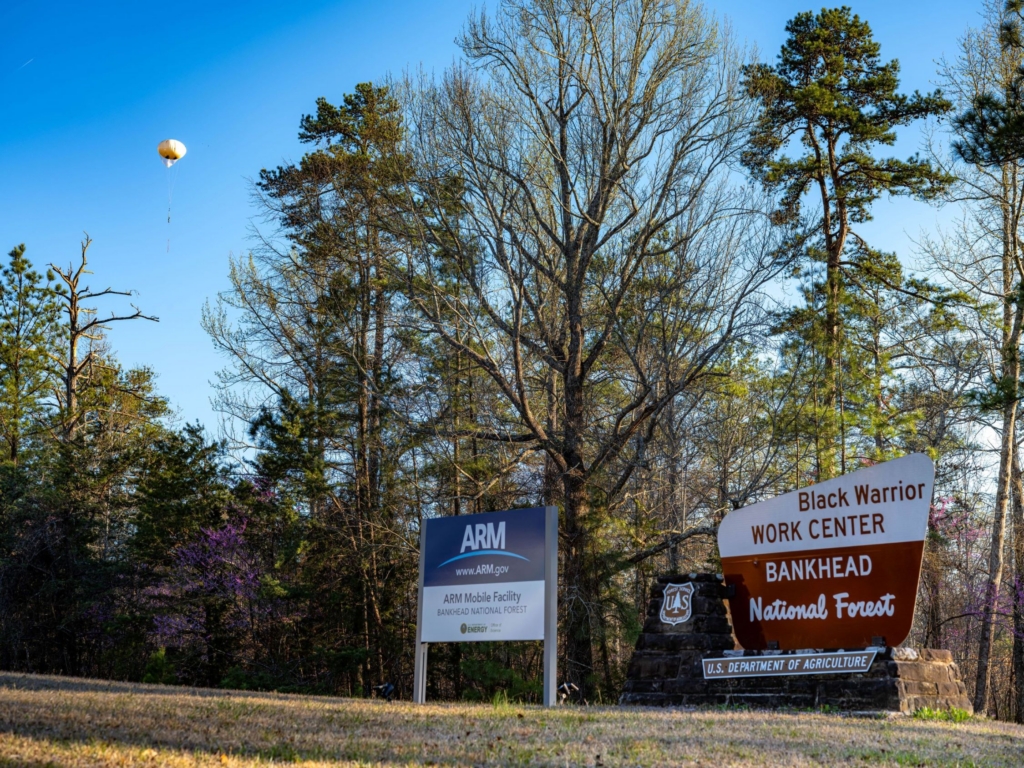
ARM’s Bankhead National Forest (BNF) atmospheric observatory began operating in October 2024 in northwestern Alabama. Researchers are using BNF data to learn about clouds, aerosols, and land-atmosphere interactions, which in turn will lead to improvements in earth system models.
- POSTER SESSION—A21D: Atmospheric Convection: Processes, Dynamics, and Links to Weather and Climate I
Tuesday, December 16, 8:30 a.m.–noon, Hall EFG (Convention Center)
Reported BNF presentations:- A21D-2053: Investigating how Different Large-Scale Environmental Conditions impact the Shallow-to-Deep Transition of Convection. Nathanael Zhixin Wong, New York University.
- A21D-2054: Local Environmental Controls on the Early Stages of Convective Cloud Development Over the Southeast U.S. Nicolas Leitmann-Niimi, NASA Goddard Institute for Space Studies/Columbia Center for Climate Systems Research.
- POSTER SESSION—A41K: Boundary Layer Clouds and Earth System Coupling
Thursday, December 18, 8:30 a.m.–noon, Hall EFG (Convention Center)
Reported BNF presentation:- A41K-2163: Convective Cloud Transitions over Bankhead National Forest: Results from Continuous LES Study. Girish Nigamanth Raghunathan, Cleveland State University.
- POSTER SESSION—A21E: NASA’s Investigation of Convective Updrafts (INCUS) Mission: Observing the Drivers of Severe Weather from Space
Tuesday, December 16, 8:30 a.m.–noon, Hall EFG (Convention Center)
Reported BNF presentation:- A21E-2074: TIME-SLICE-AL: A Leveraged Asset Field Campaign for Quantifying Convective Mass Flux using Delta-T Techniques with Adaptive Sampling.
Sean William Freeman, University of Alabama in Huntsville.
- A21E-2074: TIME-SLICE-AL: A Leveraged Asset Field Campaign for Quantifying Convective Mass Flux using Delta-T Techniques with Adaptive Sampling.
- POSTER SESSION—H33N: Advances in Remote Sensing, AI, and Modeling for Hydrology and the Terrestrial Water Cycle I
Wednesday, December 17, 2:15–5:45 p.m., Hall EFG (Convention Center)
Reported BNF presentation:- H33N-1483: Radiance-Based Evaluation of Land Surface Temperature in the HydroBlocks Land Surface Model. Jiaxuan Cai, Duke University.
- ORAL SESSION—A34D: The Living Atmosphere: Advances in Monitoring, Modeling, and Sampling of Airborne Bioaerosols I
Wednesday, December 17, 4:15–5:45 p.m., Room 271 (Convention Center)
Reported BNF presentation:- A34D-07: Springtime Pollen Rupture and Atmospheric Vertical Transport in the Southeastern US. Tamanna Subba, Brookhaven National Laboratory.
- ORAL SESSION—A41C: Atmospheric Research Supported by Uncrewed Aerial Systems and Tethered Balloon Systems I
Thursday, December 18, 8:30–10 a.m., Rooms 280–282 (Convention Center)
Reported BNF presentation:- A41C-04: Vertically-Resolved Measurements of Newly Formed Particles at the DOE ARM Bankhead National Forest Site in Northwestern Alabama.
Chongai Kuang, Brookhaven National Laboratory.
- A41C-04: Vertically-Resolved Measurements of Newly Formed Particles at the DOE ARM Bankhead National Forest Site in Northwestern Alabama.
- POSTER SESSION—A41L: Boundary Layer Processes and Turbulence I
Thursday, December 18, 8:30 a.m.–noon, Hall EFG (Convention Center)
Reported BNF presentation:
- ORAL SESSION—A43E: Advancing Understanding of Terrestrial-Atmospheric Interfaces: Linking Trace Gases, VOCs, and Aerosol Processes Across Scales I
Thursday, December 18, 2:15–3:45 p.m., Rooms 238–239 (Convention Center)
Reported BNF presentation:- A43E-04: In-situ and Off-line Characterization of Vertical Profiles of Supermicron Bioaerosols in Forest and Coastal-Urban Environments.
Maria A. Zawadowicz, Brookhaven National Laboratory.
- A43E-04: In-situ and Off-line Characterization of Vertical Profiles of Supermicron Bioaerosols in Forest and Coastal-Urban Environments.
- ORAL SESSION—A43F: Boundary Layer Processes and Turbulence II
Thursday, December 18, 2:15–3:45 p.m., Rooms 220–222 (Convention Center)
Reported BNF presentation:- A43F-02: Mean and Turbulent Flow Over a Forest, With and Without Canopy Breaks. Jerome Fast, Pacific Northwest National Laboratory.
- POSTER SESSION—A51K: Advancing Understanding of Terrestrial-Atmospheric Interfaces: Linking Trace Gases, VOCs, and Aerosol Processes Across Scales II
Friday, December 19, 8:30 a.m.–noon, Hall EFG (Convention Center)
Reported BNF presentations:- A51K-0866: Characterizing the ice nucleation potential of particles in Bankhead National Forest: Investigating the contributions and impacts of bioaerosols and biogenic particles. Katie Chan, University of California, Los Angeles.
- A51K-0871: Real-time detection and classification of biological particles using machine learning: Detection and Assessment of Their Ability to Form Clouds at Bankhead National Forest. Shreya Joshi, Pacific Northwest National Laboratory.
- POSTER SESSION—A51N: Atmospheric Research Supported by Uncrewed Aerial Systems and Tethered Balloon Systems II
Friday, December 19, 8:30 a.m.–noon, Hall EFG (Convention Center)
Reported BNF presentation:- A51N-0918: Heterogeneity of Vertically-Resolved Boundary Layer Temperature Profiles in the Bankhead National Forest. Darielle Dexheimer, Sandia National Laboratories.
Southern Great Plains (SGP)
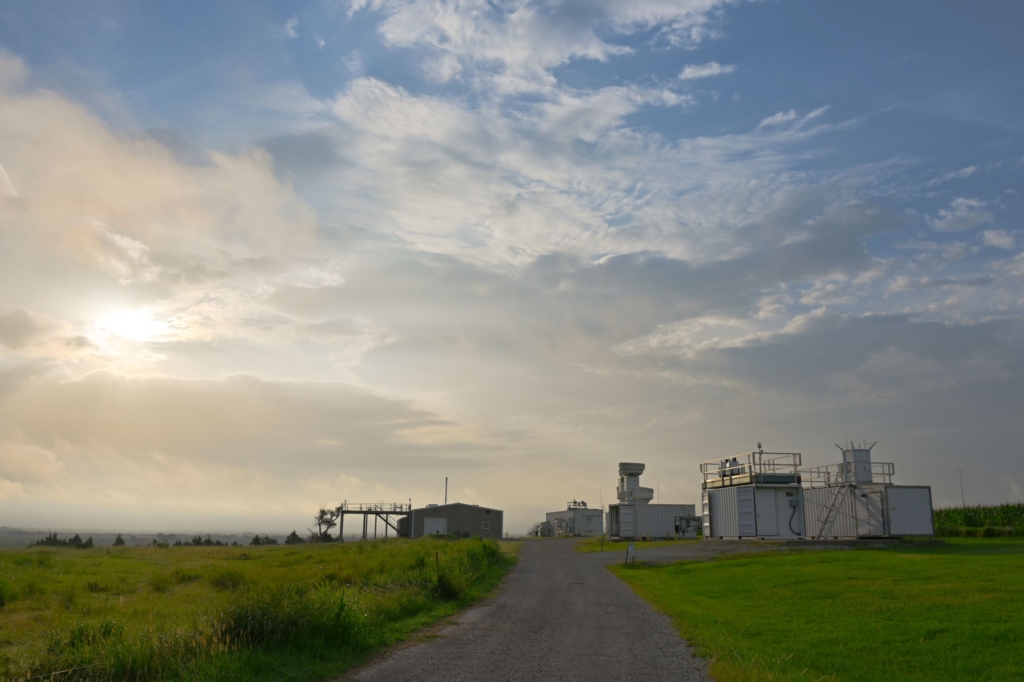
The Southern Great Plains (SGP) atmospheric observatory was the first field measurement site established by ARM. Operational since 1992, the SGP observatory consists of in situ and remote-sensing instrument clusters arrayed across north-central Oklahoma and offers high-quality data and simulations for use by the atmospheric science community.
- POSTER SESSION—A13I: Advancing Research on Atmospheric Aerosols and Their Impacts on Climate, Air Quality, and Health III
Monday, December 15, 2:15–5:45 p.m., Hall EFG (Convention Center)
Reported SGP presentation:- A13I-1785: Characterizing Horizontal Gradients of Aerosol Pollution and Chemical Speciation Across Oklahoma. Marcela Loría-Salazar, University of Oklahoma.
- POSTER SESSION—A21D: Atmospheric Convection: Processes, Dynamics, and Links to Weather and Climate I
Tuesday, December 16, 8:30 a.m.–noon, Hall EFG (Convention Center)
Reported SGP presentation:- A21D-2045: Evaluating Differences in Environmental Conditions Supporting Isolated Deep Convection vs Organized Mesoscale Convective Systems. Rebecca Weinstein, University of Virginia.
- ORAL SESSION—A24D: Identifying, Understanding, and Resolving Earth System Model Biases I
Tuesday, December 16, 4:15–5:45 p.m., Room 271 (Convention Center)
Reported SGP presentation:- A24D-01: Diagnosing Land-Atmosphere Coupling Errors in E3SMv3 Using Diurnal Metrics and ARM Observations. Shaocheng Xie, Lawrence Livermore National Laboratory.
- ORAL SESSION—A32D: Dust in a Changing Climate: From Small‐Scale Insights to Large‐Scale Understanding I
Wednesday, December 17, 10:30 a.m.–noon, Room 271 (Convention Center)
Reported SGP presentation:- A32D-01: Direct and Indirect Effects of Agricultural Dust on Climate (Invited). Xiaohong Liu, Texas A&M University.
- ORAL SESSION—A41C: Atmospheric Research Supported by Uncrewed Aerial Systems and Tethered Balloon Systems I
Thursday, December 18, 8:30–10 a.m., Rooms 280–282 (Convention Center)
Reported SGP presentation:- A41C-08: Vertical Distribution of GHGs in the Daytime and Nighttime PBL: Observations Using Ground-to-Balloon Dual Comb Spectroscopy. James Kasic, National Institute of Standards and Technology.
- ORAL SESSION—A42H: General Session: Atmospheric Chemistry, Composition, Peroxy Radicals, SOA, and Ozone II GeoBurst
Thursday, December 18, 10:30 a.m.–noon, New Orleans Theater A (Convention Center)
Reported SGP presentation:- A42H-02: Airborne Water Vapor Measurements with Open-path Dual-comb Spectroscopy. Kevin Cossel, National Institute of Standards and Technology Boulder Laboratories.
- ORAL SESSION—A43E: Advancing Understanding of Terrestrial-Atmospheric Interfaces: Linking Trace Gases, VOCs, and Aerosol Processes Across Scales I
Thursday, December 18, 2:15–3:45 p.m., Rooms 238–239 (Convention Center)
Reported SGP presentation:- A43E-03: Vertically Resolved Distributions/Chemical Speciation of Anthropogenic, Biogenic, and Biomass Burning Organic Aerosols at the Southern Great Plains. Shan Gu, University of California, Berkeley.
- ORAL SESSION—A43F: Boundary Layer Processes and Turbulence II
Thursday, December 18, 2:15–3:45 p.m., Rooms 220–222 (Convention Center)
Reported SGP presentations:- A43F-04: Assessing the Role of Land-Atmosphere Feedbacks during the 2017 and 2024 Solar Eclipses using the High-Resolution Rapid Refresh (HRRR). Thijs Heus, Cleveland State University.
- A43F-06: Improving Turbulent Flux Estimates and Similarity Theory Performance for Stable Atmospheric Boundary Layers. Mohamed Zamzam, University of Utah.
- POSTER SESSION—A43S: Air Pollution and Well-Being: Bridging Surface, Space, and Modeling Studies I
Thursday, December 18, 2:15–5:45 p.m., Hall EFG (Convention Center)
Reported SGP presentation:- A43S-2389: Exploring Comparability of Aerosol Mass Concentrations and Speciations: Updated Results from the DOE ARM SPICE Campaign. Emily West, University of Oklahoma.
- ORAL SESSION—A51E: General Session: Aerosols, New Particle Formation, and Clouds II
Friday, December 19, 8:30–10 a.m., Room 245 (Convention Center)
Reported SGP presentation:- A51E-02: Role of Amines in Determining Vertical Gradients in New Particle Formation in the Southern Great Plains. Bri Dobson, University of Colorado Boulder.
- POSTER SESSION—A51K: Advancing Understanding of Terrestrial-Atmospheric Interfaces: Linking Trace Gases, VOCs, and Aerosol Processes Across Scales II
Friday, December 19, 8:30 a.m.–noon, Hall EFG (Convention Center)
Reported SGP presentation:- A51K-0864: 3D Chemical Imaging reveals surface and internal heterogeneity of airborne fungal spores. Zezhen Cheng, Pacific Northwest National Laboratory.
- POSTER SESSION—A51M: Atmospheric Aerosols and Their Interactions with Clouds, Radiation, and Climate IV
Friday, December 19, 8:30 a.m.–noon, Hall EFG (Convention Center)
Reported SGP presentation:
- POSTER SESSION—A51V: Integrated Perspectives of Aerosol’s Origin, Properties, Deposition, and Impacts: Implications for Acid Rain, Radiative Forcing, Climate Change, Vegetation, Materials, and Public Health
Friday, December 19, 8:30 a.m.–noon, Hall EFG (Convention Center)
Reported SGP presentation:- A51V-1061: Investigating Long-Range Smoke Transport to the Southern Great Plains, USA via Weather Regimes. Kyle Eskew, University of Oklahoma.
- ORAL SESSION—A52C: Boundary Layer Processes and Turbulence IV
Friday, December 19, 10:30 a.m.–noon, Rooms 275–277 (Convention Center)
Reported SGP presentation:- A52C-07: Large Eddy Simulations of the response of the atmospheric boundary layer to solar eclipses. Thijs Heus, Cleveland State University.
Featured Field Campaign Presentations
Cloud And Precipitation Experiment at kennaook (CAPE-k)
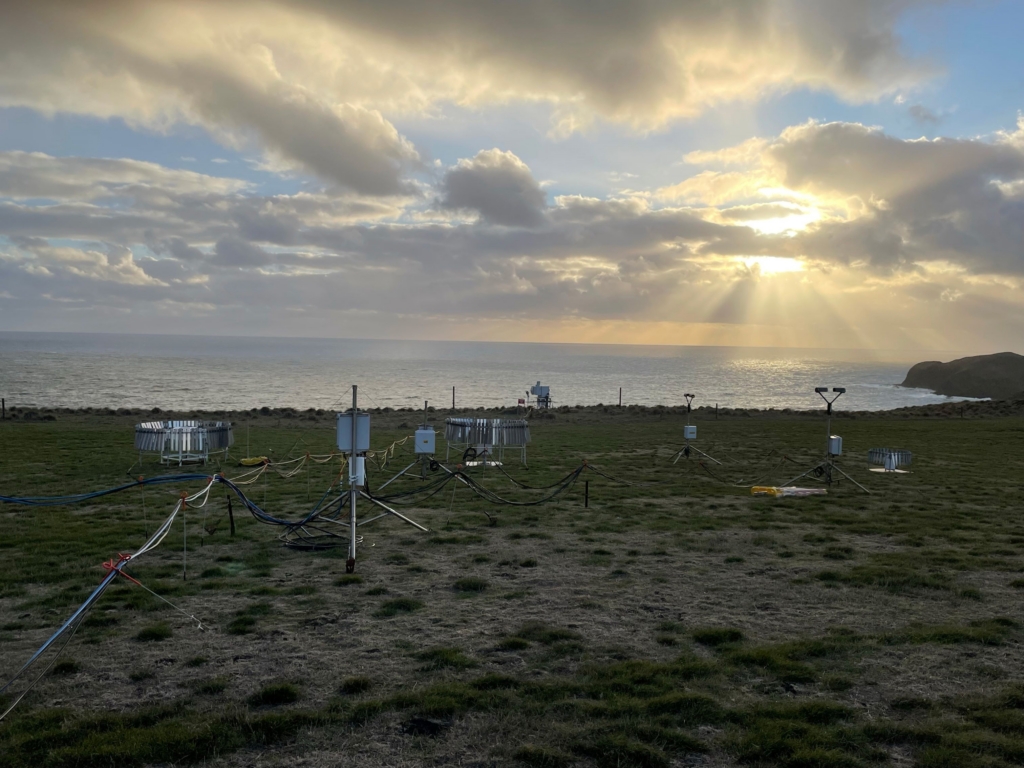
The Cloud And Precipitation Experiment at kennaook (CAPE-k) operated from April 2024 to October 2025 in northwestern Tasmania. As part of the campaign, ARM deployed one of its mobile observatories at the Kennaook / Cape Grim Baseline Air Pollution Station. ARM measurements augmented routine aerosol data collected at the station, including aerosol size distribution, particle number concentration, light absorption and scattering, and mass and chemical composition.
Researchers are analyzing CAPE-k data to learn more about aerosol-cloud-precipitation interactions and help reduce a large source of uncertainty in earth system models.
- ORAL SESSION—A24F: Observation and Model Studies of Cloud Properties and Associated Processes II
Tuesday, December 16, 4:15–5:45 p.m., Rooms 267–268 (Convention Center)
Reported CAPE-k presentation:- A24F-07: Tracking the Sensitivity of Cloud Properties over the Southern Ocean to Cloud Morphology. Tahereh Alinejadtabrizi, Monash University.
- POSTER SESSION—A41K: Boundary Layer Clouds and Earth System Coupling
Thursday, December 18, 8:30 a.m.–noon, Hall EFG (Convention Center)
Reported CAPE-k presentation:- A41K-2170: Southern Ocean Mesoscale Cellular Convection and Cold Pools. Litai Kang, University of Washington.
- POSTER SESSION—A51Y: The Spectral Dimension of Shortwave and Longwave Radiation in the Earth System II
Friday, December 19, 8:30 a.m.–noon, Hall EFG (Convention Center)
Reported CAPE-k presentation:- A51Y-VR8874: Spectral Outgoing Longwave Radiation Measured by the Polar Radiant Energy in the Far Infrared Experiment (PREFIRE). Xianglei Huang,
University of Michigan, Ann Arbor.
- A51Y-VR8874: Spectral Outgoing Longwave Radiation Measured by the Polar Radiant Energy in the Far Infrared Experiment (PREFIRE). Xianglei Huang,
TRacking Aerosol Convection interactions ExpeRiment (TRACER)
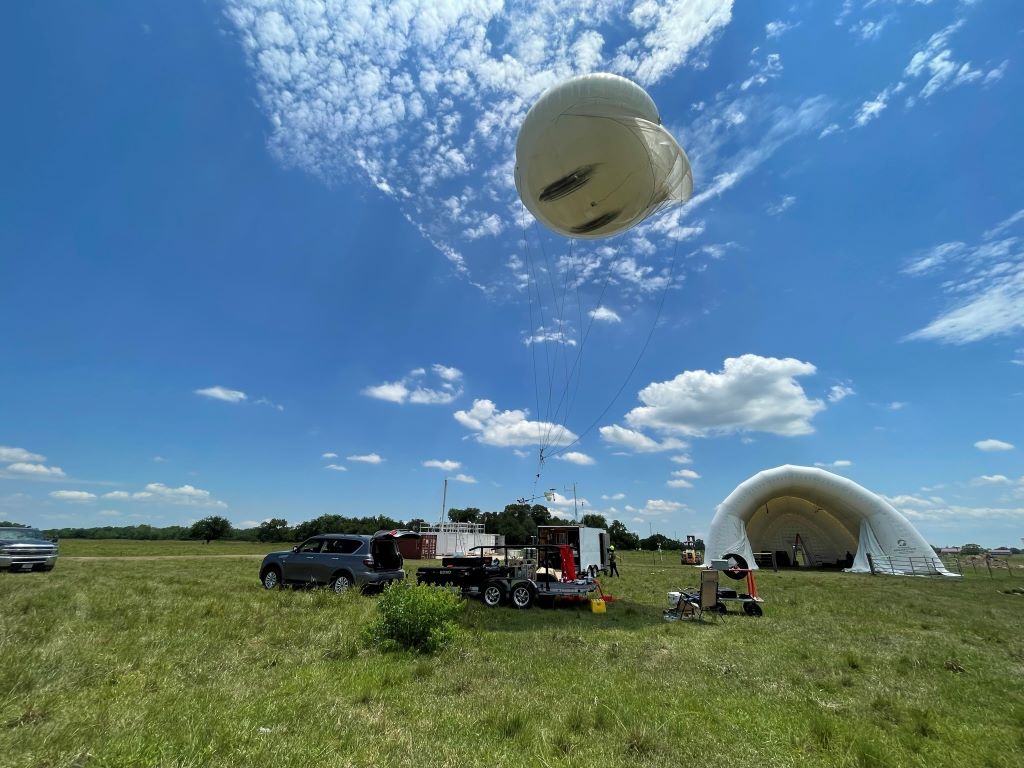
The TRacking Aerosol Convection interactions ExpeRiment (TRACER), which ran from October 2021 through September 2022, provided convective cloud observations with high space and time resolution over a broad range of environmental and aerosol conditions around the Houston, Texas, region.
As part of TRACER, ARM deployed a mobile observatory southeast of downtown Houston, a scanning precipitation radar south of downtown, and an ancillary site southwest of the city, where tethered balloon systems were launched. Together, these ARM measurements are helping researchers better understand the variability of aerosols and meteorology between the urban Houston area and surrounding rural environments.
- ORAL SESSION—A11B: Advancing Research on Atmospheric Aerosols and Their Impacts on Climate, Air Quality, and Health I
Monday, December 15, 8:30–10 a.m., Room 342 (Convention Center)
Reported TRACER presentation:- A11B-03: Cloud and Radiation Characteristics Associated with Sea-Breeze Boundaries in the Southeast Texas Region. Michelle Jones, Texas Southern University.
- POSTER SESSION—A21B: Advances in Cloud and Precipitation Processes: Integrating Observations, Modeling, and Theory III
Tuesday, December 16, 8:30 a.m.–noon, Hall EFG (Convention Center)
Reported TRACER presentation:- A21B-2033: Secondary Ice Production in Deep Convective Clouds over Coastal Urban Areas: Insights from TRACER Radar Observations and Large-Eddy Simulations. Yongjie Huang, University of Oklahoma.
- POSTER SESSION—A21D: Atmospheric Convection: Processes, Dynamics, and Links to Weather and Climate I
Tuesday, December 16, 8:30 a.m.–noon, Hall EFG (Convention Center)
Reported TRACER presentation:- A21D-2057: Scientific Insights from Novel Radar Scan Strategies and Deep Convection Tracking over Houston, Texas. Siddhant Gupta, Argonne National Laboratory.
- ORAL SESSION—A23C: Atmospheric Convection: Processes, Dynamics, and Links to Weather and Climate II
Tuesday, December 16, 2:15–3:45 p.m., Room 270 (Convention Center)
Reported TRACER presentation:- A23C-05: Investigating the Impacts of Convective Downdraft Outflow on Boundary Layer Aerosol and Thermodynamic Properties during TRACER.
Michael P. Jensen, Brookhaven National Laboratory.
- A23C-05: Investigating the Impacts of Convective Downdraft Outflow on Boundary Layer Aerosol and Thermodynamic Properties during TRACER.
- ORAL SESSION—A24G: Understanding and Modeling of Mesoscale and Severe Local Convective Storm Processes II
Tuesday, December 16, 4:15–5:45 p.m., Room 270 (Convention Center)
Reported TRACER presentation:- A24G-08: Impact of horizontal resolutions on the simulation sea breezes during the TRACER field campaign. Hsi-Yen Ma, Lawrence Livermore National Laboratory.
- ORAL SESSION—A42B: Atmospheric Aerosols and Their Interactions with Clouds, Radiation, and Climate II
Thursday, December 18, 10:30 a.m.–noon, Room 271 (Convention Center)
Reported TRACER presentation:- A42B-08: Dust and Primary Biological Aerosol Effects on Sea Breeze Systems over Houston. Qiuyan Du, University of Michigan, Ann Arbor.
- POSTER SESSION—A43R: AI-Driven Innovations in Earth and Atmospheric Sciences I
Thursday, December 18, 2:15–5:45 p.m., Hall EFG (Convention Center)
Reported TRACER presentation:- A43R-2370: Geophysical Retrievals in an Artificial Intelligence (AI) Framework. Virendra P. Ghate, Argonne National Laboratory.
- POSTER SESSION—A51N: Atmospheric Research Supported by Uncrewed Aerial Systems and Tethered Balloon Systems II
Friday, December 19, 8:30 a.m.–noon, Hall EFG (Convention Center)
Reported TRACER presentations:- A51N-0917: Evaluating sea-breeze induced changes to atmospheric turbulence using uncrewed aircraft systems and surface-based sensors during TRACER. Gijs de Boer, Brookhaven National Laboratory.
- A51N-0923: Vertical Mixing of Aerosol Properties: A Tethered Balloon Study. Jayla Fontenette, Texas Southern University.

Follow Us:






Keep up with the Atmospheric Observer
Updates on ARM news, events, and opportunities delivered to your inbox
ARM User Profile
ARM welcomes users from all institutions and nations. A free ARM user account is needed to access ARM data.