An official website of the United States government





EPCAPE Data Could Hold Key to New Understanding of Cloud Droplet Formation
Published: 19 February 2026
Measurement analysis reveals information that contradicts existing thermodynamic models
Editor’s note: The following is based on a February 2026 news release by the University of California, Riverside (UCR).
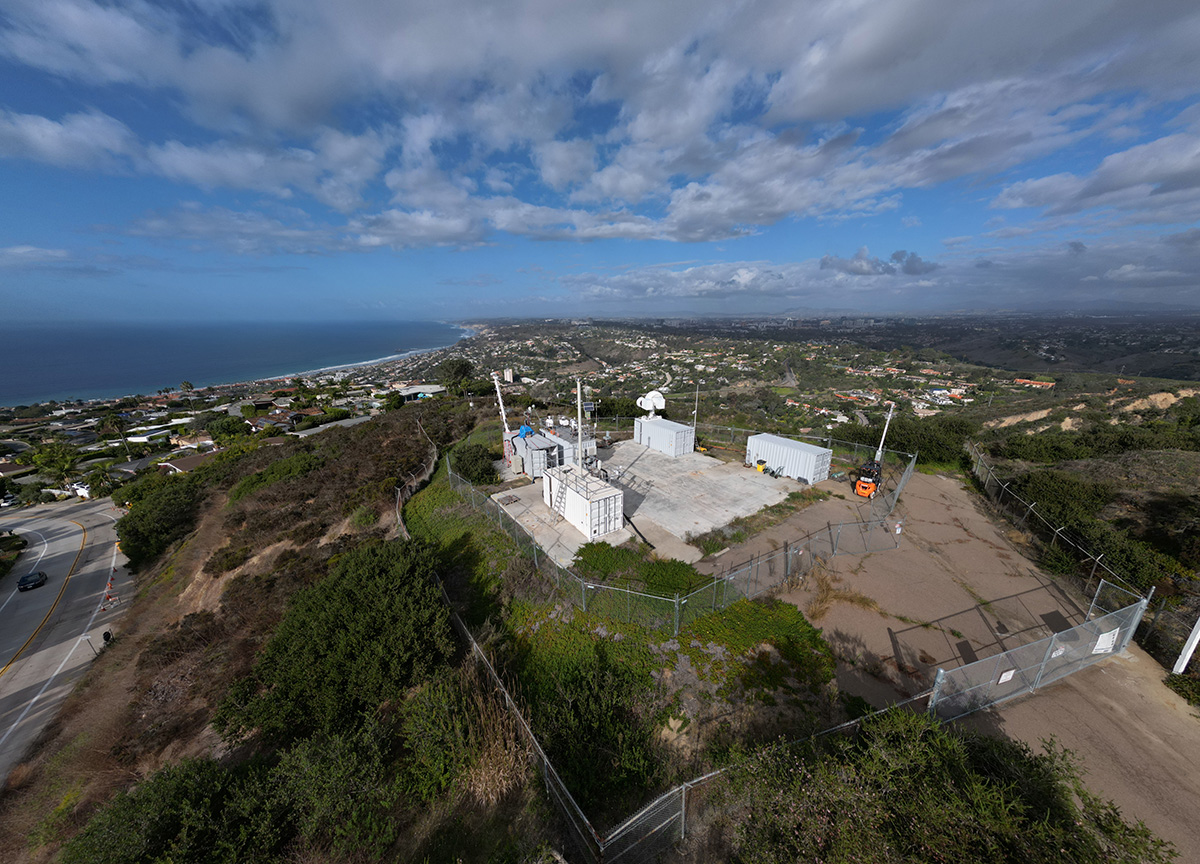
Measurements taken as part of a recent Atmospheric Radiation Measurement (ARM) User Facility field campaign could help transform understanding of the fundamental mechanisms involved in cloud droplet formation.
Near the top of Mount Soledad in La Jolla, California, researchers collected air samples during ARM’s 2023–2024 Eastern Pacific Cloud Aerosol Precipitation Experiment (EPCAPE). The researchers wanted to see if removing gases present in the air at low concentrations affected the ability of water vapor to condense around particles and become cloud droplets. Their findings appear in a January 2026 Science Advances paper led by UCR doctoral student Elavarasi Ravichandran.
In the air samples, researchers looked at hygroscopicity—the capacity of particles to attract and take up moisture from the environment. Using a charcoal-based scrubbing device called a denuder, they removed small volatile organic gases with fewer than 10 carbon atoms from the samples. The team found that the hygroscopicity of the particles increased or decreased when the gases were removed.
The study also showed that the gases behaved differently than expected in some cases, suppressing droplet formation instead of promoting it.
“That was the second surprise,” said co-author and EPCAPE co-investigator Markus Petters, a UCR atmospheric chemist who led a small ARM campaign on coastal cloud chemistry during EPCAPE. “The gases had the opposite effect of what thermodynamic models would suggest. It means we need to go back and re-examine the basic physics of how particles and gases interact at the microscopic level.”
For more information about the research, please read the full UCR news release.

Follow Us:






Keep up with the Atmospheric Observer
Updates on ARM news, events, and opportunities delivered to your inbox
ARM User Profile
ARM welcomes users from all institutions and nations. A free ARM user account is needed to access ARM data.