An official website of the United States government





New Directions in Atmospheric Ice Processes Research
Published: 28 May 2026
DOE workshop maps out next steps for improving earth system models
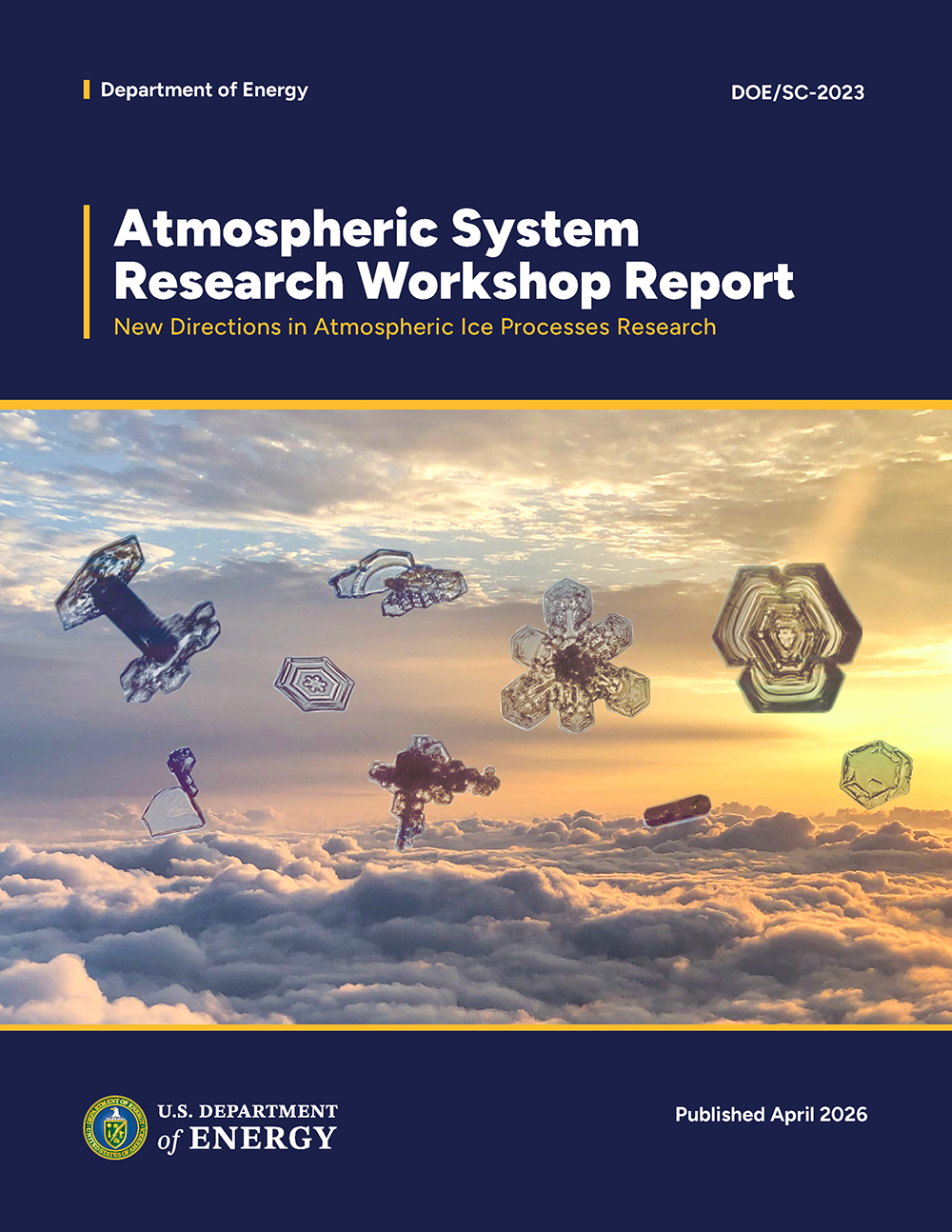
Atmospheric ice processes are critical to precipitation formation, cloud dynamics, and cloud radiative properties. They contribute to uncertainties in Earth’s energy budget and hydrological cycle, yet they remain poorly understood.
An incomplete understanding of these fundamental processes and the challenges of accurately representing their impacts can limit the predictive capabilities of earth system models (ESMs) for informing energy sector questions.
To address these issues, the U.S. Department of Energy’s (DOE’s) Atmospheric System Research (ASR) activity organized a workshop that brought together experts in laboratory measurements, field observations, and modeling. The primary goal was to identify key knowledge gaps and prioritize future directions for research on atmospheric ice processes.
A new DOE report, New Directions in Atmospheric Ice Processes Research, summarizes the workshop’s outcomes and outlines priorities for improving how ESMs represent ice formation and cloud evolution.
An international team of 28 scientists from academia, national laboratories, and federal agencies authored the report.
Many of the authors work with data from DOE’s Atmospheric Radiation Measurement (ARM) User Facility. The report notes contributions by ARM, ASR, and predecessor programs to significant progress in understanding atmospheric ice processes, including conducting field campaigns, developing ground-based remote sensing and retrieval products, and leading and supporting model intercomparison studies.
Why Ice Processes Matter
Cloud ice forms through two main pathways. The first, known as primary ice production, occurs when atmospheric particles trigger freezing. Secondary ice production occurs when existing ice crystals produce additional ice. Researchers say both processes are difficult to measure and simulate accurately.
The workshop identified a major gap in understanding: Real-world atmospheric observations often show far more ice crystals than current theories can explain. Scientists also face challenges in measuring small ice crystals, large aerosol particles, and the rapid vertical air motions within clouds.
The resulting knowledge gaps constrain the performance of large-scale ESMs used for simulating cloud processes and atmospheric dynamics.
Future Directions Identified
The report outlines several priorities for future research, including the use of existing and new ARM capabilities and data sets to advance understanding of atmospheric ice processes.
A recurring theme throughout the report is the need to better connect observations with modeling efforts.
Researchers say future progress will depend on integrating ARM campaigns, laboratory work, and high-resolution simulations. That approach could improve how ESMs represent cloud formation, precipitation processes, and atmospheric energy transfer.
Workshop participants pointed to advances in machine learning and computing power as tools that could help bridge the gap between small-scale cloud physics and large-scale model simulations. Moreover, participants discussed how artificial intelligence can significantly advance the understanding of cloud dynamics and the spatial heterogeneity of ice clouds in ESMs.
The full report is available from DOE’s Office of Science.

Follow Us:






Keep up with the Atmospheric Observer
Updates on ARM news, events, and opportunities delivered to your inbox
ARM User Profile
ARM welcomes users from all institutions and nations. A free ARM user account is needed to access ARM data.