An official website of the United States government





Tracing the Life Story of Atmospheric Particles
Published: 30 July 2026
DOE SCGSR awardee uses ARM data to connect aerosols across scales

When Steven Sharpe studies microscopic airborne particles, he isn’t simply measuring their chemistry. He’s reconstructing how they form, evolve in the atmosphere, and ultimately influence clouds, radiation, and other earth system processes.
Before pursuing his doctorate in chemistry at Purdue University in Indiana, Sharpe studied chemistry and anthropology at Grinnell College in Iowa. That training taught him to interpret artifacts within their broader context—a perspective he now applies to atmospheric science.
Sharpe views scientific research much like storytelling: identifying unanswered questions, gathering evidence, and ultimately assembling a coherent explanation.
“Context is the most important thing,” he says. “We have the samples and do the science, but those are often removed from context.”
Rather than treating particle measurements in isolation, for example, Sharpe combines laboratory analyses with satellite imagery, field observations, and atmospheric records to determine a particle’s story—where it originated and how it changed as it traveled through the atmosphere.
It’s an interdisciplinary approach that recently helped Sharpe earn a U.S. Department of Energy (DOE) Office of Science Graduate Student Research (SCGSR) award. It brought him to Pacific Northwest National Laboratory (PNNL) in Washington state, where he is collaborating with atmospheric scientist Fan Mei while using observations collected through DOE’s Atmospheric Radiation Measurement (ARM) User Facility.
An Award for Future Scientists
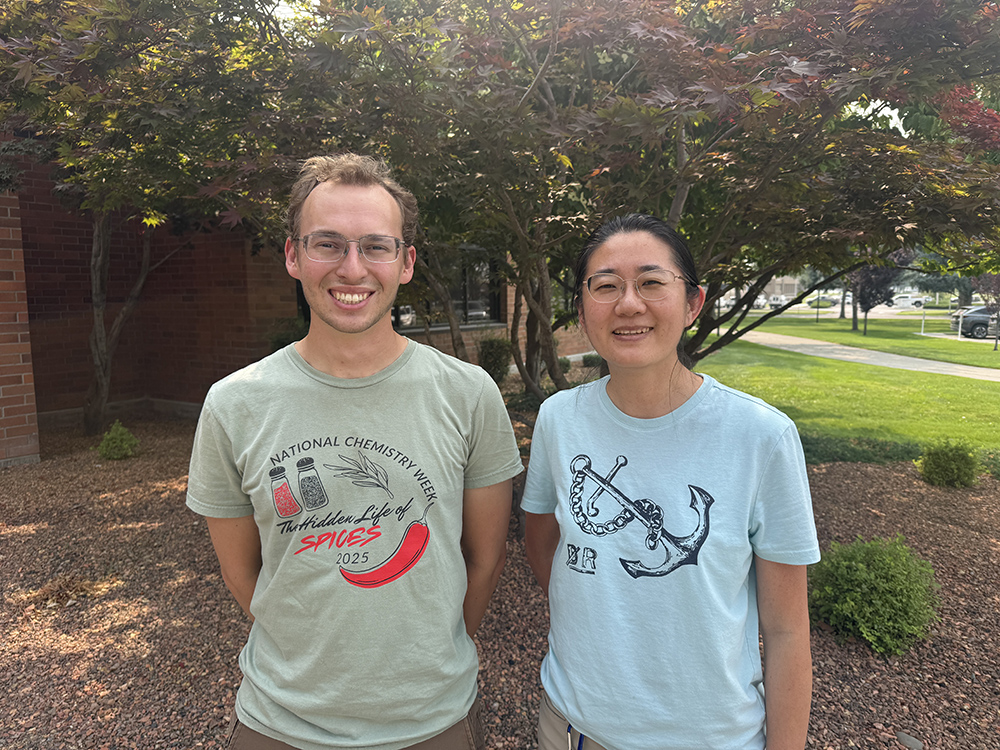
The SCGSR program prepares graduate students for careers in science, technology, engineering, and mathematics by supporting thesis research at DOE national laboratories. Awardees spend three to 12 consecutive months working alongside laboratory scientists, gaining access to world-class facilities, expertise, and capabilities while addressing scientific challenges central to the Office of Science’s mission.
Sharpe’s project started in July 2026 and is scheduled to conclude in early December. It will combine ARM airborne observations with advanced chemical analyses available through the Environmental Molecular Sciences Laboratory (EMSL), a DOE Office of Science user facility at PNNL.
EMSL houses specialized instruments that enable chemical characterization of individual aerosols—tiny airborne particles that influence large atmospheric processes—at microscopic scales not available at most universities.
Together, Sharpe and Mei will work to deepen the fundamental understanding of how aerosol composition varies with altitude across different landscapes and to improve the interpretation of remote sensing observations. Aerosol composition often changes as particles age, interact with clouds, or mix with different sources, making altitude an important indicator of those processes.
A Strong Research Foundation
The SCGSR work at PNNL will contribute to Sharpe’s doctoral dissertation. At Purdue, he is part of the Alexander Laskin Research Group, an interdisciplinary laboratory focused on the chemistry and physical properties of atmospheric particles and environmental interfaces.
Laskin, a professor of analytical chemistry, is a former PNNL atmospheric scientist who has led research projects for ARM and DOE’s Atmospheric System Research (ASR) activity.
“Steven brings a rare combination of sophisticated analytical chemistry expertise and a strong interest in integrative science, connecting measurements across multiple scales,” says Laskin.
Connecting Chemistry, Remote Sensing, and Aerial Data
Improving observational analyses for Sharpe’s project begins with examining aerosols, which influence cloud formation, precipitation, and Earth’s energy balance. These particles are often considered to be among the largest remaining uncertainties in forecasting.
Using scanning transmission X-ray microscopy and other advanced analytical techniques, Sharpe will map the chemical composition and internal structure of individual particles. That information can help him more accurately estimate how particles scatter and absorb light, properties that underpin satellite retrievals and atmospheric models.
The resulting insights may improve the interpretation of atmospheric observations and strengthen the representation of aerosols in earth system models (ESMs). The improved observations may also support the development of new artificial intelligence approaches for atmospheric science.
For Mei, the SCGSR work brings together capabilities that are rarely combined.
“Long-term remote sensing observations, direct airborne measurements, and detailed laboratory chemistry—each captures a different part of the atmospheric system,” she says. “Integrating them offers an opportunity to address longstanding gaps in atmospheric observations.”
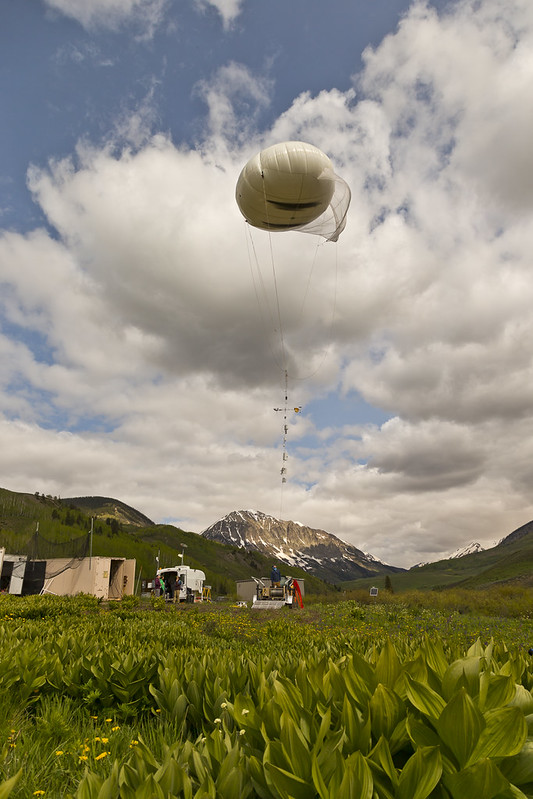
The collaboration builds on a relationship that began during ARM’s 2021–2023 Surface Atmosphere Integrated Field Laboratory (SAIL) campaign in Colorado, where Sharpe first worked with ARM observations as a graduate student. During SAIL, Sharpe managed an aethalometer deployed for the campaign to measure the concentration of light-absorbing aerosols in the atmosphere. He also led sample collection, analysis, and data processing.
He will expand on that work during his SCGSR project by using tethered balloon system data sets from SAIL and by developing methods that could be applied to future ARM field campaigns. He and Mei are also looking at how data from ARM’s Bankhead National Forest atmospheric observatory in Alabama might be integrated into the project.
Toward Better Atmospheric Predictions
Ultimately, Sharpe hopes to generate advances that lead to long-term insights from ESMs, such as DOE’s Energy Exascale Earth System Model (E3SM).
“By improving the physical representation of aerosols in models, we can contribute to more reliable predictions over time,” he says.
Those improvements have practical value beyond daily forecasts, supporting ESMs that help inform decisions involving the energy sector, transportation planning, or national security.
Next Call for SCGSR Applications
Graduate students will soon have an opportunity to apply for the next SCGSR solicitation call. Applications for 2026 Solicitation 2 are expected to open in August and close in November. Learn more on the SCGSR website.
Author: Mike Wasem, Staff Writer, Pacific Northwest National Laboratory
# # #ARM is a DOE Office of Science user facility operated by nine DOE national laboratories.

Follow Us:






Keep up with the Atmospheric Observer
Updates on ARM news, events, and opportunities delivered to your inbox
ARM User Profile
ARM welcomes users from all institutions and nations. A free ARM user account is needed to access ARM data.