An official website of the United States government





Charting a Bold Course for AI Integration
Published: 12 March 2026
A phased approach prioritizes transparent governance, AI‑ready infrastructure, and user engagement to accelerate discovery across the ARM community
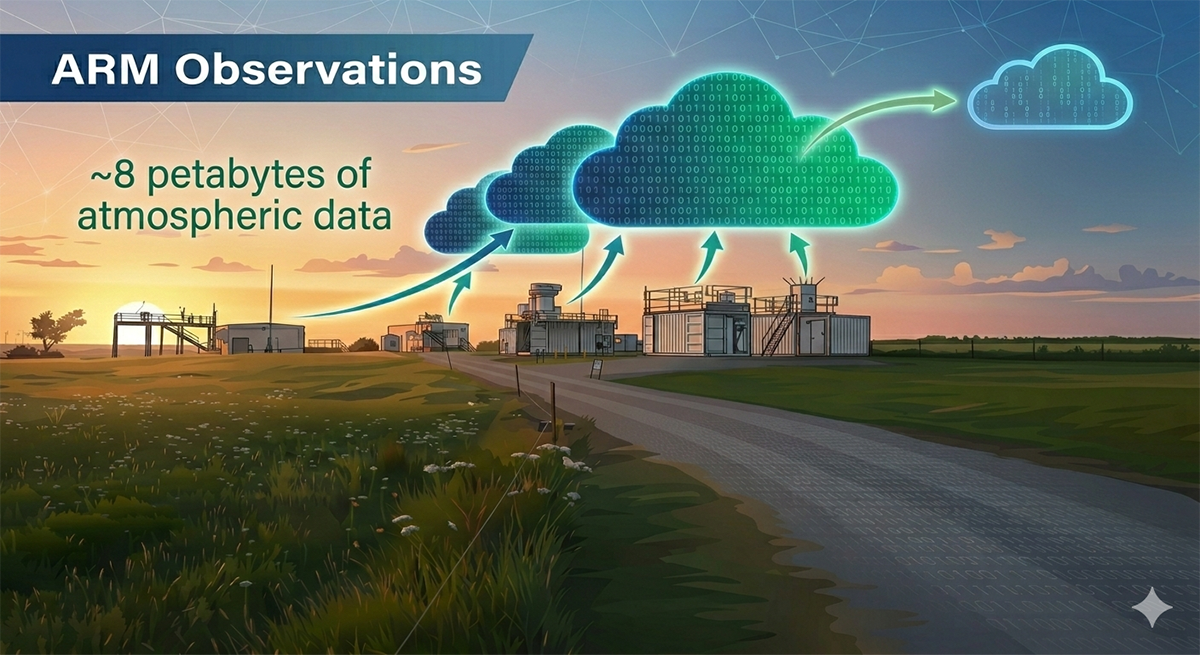
Artificial intelligence (AI) is rapidly reshaping nearly every scientific discipline, and atmospheric research is no exception.
The U.S. Department of Energy’s (DOE’s) Atmospheric Radiation Measurement (ARM) User Facility is embracing this transformation with a comprehensive new AI plan that sets priorities for infrastructure, governance, and community engagement, while promoting responsible use of AI across ARM’s operations and user services.
“AI is no longer a future concept; it’s a present reality,” says ARM Director Jim Mather. “We’re committed to responsibly harnessing the promise of AI to help ARM users accelerate atmospheric science and deliver insights that matter.”
A New Genesis for Atmospheric Science
ARM’s AI plan supports DOE’s sweeping national AI initiative, the Genesis Mission. The goal of the mission is to develop an integrated platform that connects the world’s best supercomputers, experimental facilities, AI systems, and unique data sets across every major scientific domain to double the productivity and impact of U.S. research and innovation within a decade.
Applied to atmospheric challenges, AI can accelerate scientific discovery from ARM’s observations and data products and enhance user services, while ensuring these technologies remain trustworthy and aligned with ARM’s long-term strategic planning.
Why the Plan Matters

ARM’s AI plan focuses on cutting-edge infrastructure, rigorous governance, and active community engagement, ensuring AI serves as a trusted partner in advancing atmospheric science.
“We have always strived to advance science through innovation in observations,” says Mather. “By making our vast data archive AI-ready and accessible to the user community, we’re not just keeping pace with technology. We’re giving researchers the tools to ask bigger questions and find answers faster than ever before.”
With guidance from ARM’s 2020 Decadal Vision and clear-cut direction provided by ARM’s 2024 Triennial Review—a comprehensive evaluation of ARM’s effectiveness in science, management, and operations by an external panel of experts—ARM Instrument Operations Manager Adam Theisen initiated the job of developing the AI plan.
The plan will guide the responsible and effective integration of AI across ARM, providing the research community with advanced tools to foster scientific discovery and operational efficiency.
“From cloud classification to anomaly detection, AI is touching nearly every aspect of ARM’s operations,” says Theisen. “Ultimately, these tools will help us process data faster and help users gain new insights that were not possible previously.”
A Decade of AI: From Experiments to a Clear Vision
“We have always strived to advance science through innovation in observations. By making our vast data archive AI-ready and accessible to the user community, we’re not just keeping pace with technology. We’re giving researchers the tools to ask bigger questions and find answers faster than ever before.”
ARM Director Jim Mather
Like much of the atmospheric science field, ARM’s transition to AI-driven strategies is not new. Early work included neural networks for microwave radiometer retrievals and a machine learning-based cloud mask data product by 2019. Interest surged again in 2022–2023, but without a formal structure, progress was uneven.
In April 2025, ARM launched the AI in ARM Working Group, a cross-functional team that inventoried ongoing activities and set a forward vision, forming subgroups focused on data products, anomaly detection, infrastructure, governance, and community engagement. These priorities were reported to DOE, highlighting five key areas:
- AI-ready infrastructure (a secure and scalable foundation of hardware and software, designed to handle intense AI workloads) at the ARM Data Center
- evaluation, governance, and standards
- accelerating scientific discovery through advanced data products
- AI for ARM staff to improve workflows and data quality
- AI for the ARM community, including hackathons and training.
Less than a year later, more than 20 AI initiatives have started or are being explored.
Inside the New AI Plan
AI development priorities in fiscal year 2026 outline a phased approach: build a sustainable foundation, integrate AI into workflows, and advance toward mature, trusted systems. Key actions include:
- Infrastructure: Add graphics processing units (GPUs) and AI-ready storage at the ARM Data Center; enable autonomous AI agents to run efficiently on ARM’s data systems; explore connections with DOE leadership computing facilities.
- Governance: Develop an AI governance plan; define ethics standards aligned with DOE principles; create evaluation standards and best-practice documentation.
- Scientific Discovery: Transition pilot AI projects into production-level data products; launch hackathons to create AI-ready data sets; develop new value-added products, such as ice particle habit identification.
- Community Engagement: Incorporate AI into ARM summer schools; host hackathons and seminars; release AI-powered tools to help users explore data and search ARM.gov.
AI in ARM Team Supporting Responsible AI Use

At the heart of this initiative is Scott Collis, ARM’s newly appointed AI in ARM coordinator.
Collis, an atmospheric scientist at Argonne National Laboratory in Illinois, brings ARM experience as a science translator, instrument mentor, and workforce development coordinator. He serves as an editor for the American Meteorological Society journal Artificial Intelligence for the Earth Systems, and he has a strong network in environmental information technology.
“AI has an amazing potential to enhance our productivity and help us achieve ARM’s mission. But it also comes with huge challenges,” says Collis. “Our vision is the responsible use of AI that boosts the impact of the facility and empowers staff and users.”
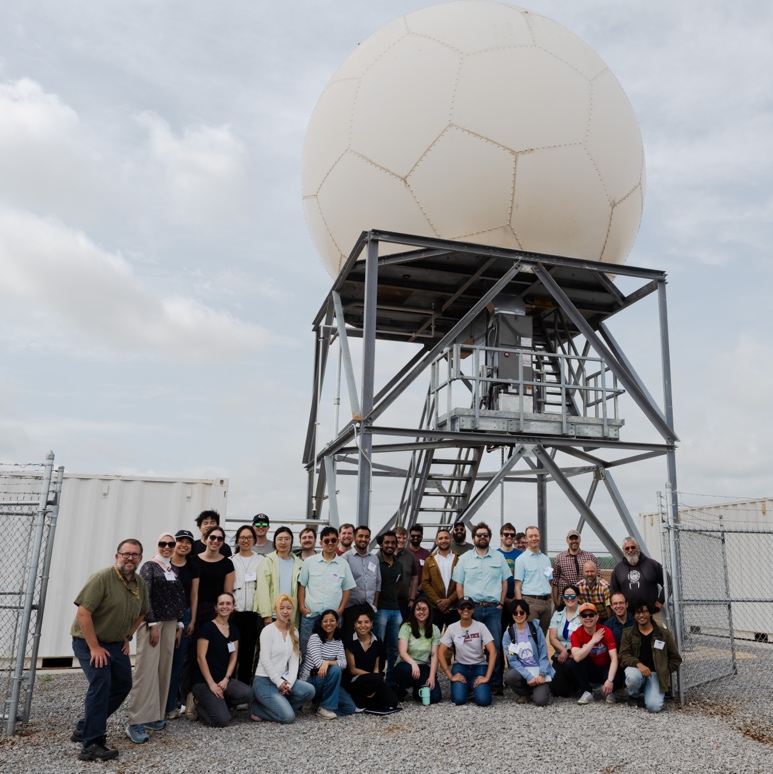
Collis leads the new AI in ARM Team, which consists of existing ARM staff with AI experience in atmospheric science, cyberinfrastructure, metadata, and the private sector. This team will collaborate to develop an ARM governance document for AI and support AI activities in ARM.
The team includes data analyst Jingjing Tian and software engineer Carina Lansing, both at Pacific Northwest National Laboratory in Washington state; and metadata lead Hannah Collier and software developer/data science engineer Chirag Shah, both from Oak Ridge National Laboratory in Tennessee.
“As custodians of one of the world’s largest atmospheric data archives, it’s our responsibility to make this data AI-ready and ensure it drives meaningful scientific discovery,” says Collis. “Done right, AI won’t replace science; it will supercharge it.”
Upcoming Opportunities for Community Engagement With AI
In the coming months, AI topics will be integrated into ARM’s May 2026 summer school in Oklahoma and the July 2026 Joint ARM User Facility/Atmospheric System Research (ASR) Principal Investigators Meeting.
To make sure the AI plan aligns with the needs of the scientific community, ARM is preparing to host an AI webinar for users in spring 2026. The session will feature lightning talks from project leads and outline opportunities for community involvement in ARM AI activities. Collis also wants user input on how AI would be most useful in helping them work with ARM data. Webinar details will be announced soon on ARM’s website.
“Our goal is to create a cohesive AI strategy that empowers both ARM staff and the broader research community,” says Collis. “By embedding AI into workflows and data products, we will ensure that our observations continue to support scientific discovery.”
Author: Mike Wasem, Staff Writer, Pacific Northwest National Laboratory
# # #ARM is a DOE Office of Science user facility operated by nine DOE national laboratories.

Follow Us:






Keep up with the Atmospheric Observer
Updates on ARM news, events, and opportunities delivered to your inbox
ARM User Profile
ARM welcomes users from all institutions and nations. A free ARM user account is needed to access ARM data.