An official website of the United States government





Particles in motion: tracking aerosols with precision and a touch of randomness
Submitter
Riemer, Nicole — University of Illinois Urbana-Champaign
West, Matthew — University of Illinois at Urbana-Champaign
Area of Research
Aerosol Processes
Journal Reference
Curtis J, N Riemer, and M West. 2024. "Explicit stochastic advection algorithms for the regional-scale particle-resolved atmospheric aerosol model WRF-PartMC (v1.0)." Geoscientific Model Development, 17(22), 10.5194/gmd-17-8399-2024.
Science
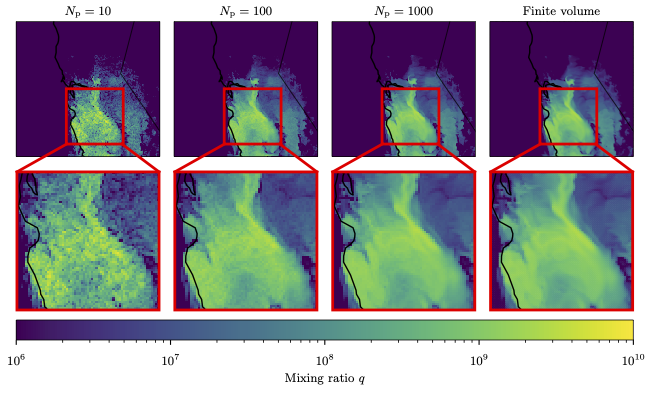
This figure illustrates the convergence of our method toward the finite-volume reference solution as the number of computational particles increases from 10 to 100 to 1000. It depicts the spatial distributions of aerosol number concentration across the California modeling domain. Image from journal.
Particle-resolved aerosol modeling is a powerful tool in aerosol research because it captures critical processes and properties that bulk or simplified models often miss. Our work introduces a new method for simulating aerosol transport processes for particle-resolved models, thereby enabling the use of these models on the regional scale.
Impact
Particle-resolved modeling is a highly detailed approach to simulate the evolution of the atmospheric aerosol. Embedding such a model into a 3D chemical transport model such as the Weather Research and Forecast (WRF) model allows us to study the interactions of aerosol processes with the transport in the atmosphere with unprecedented detail. This, in turn, is key for predicting the impact of aerosol-cloud and aerosol-radiation interactions on climate.
Summary
This study introduces a numerical method for simulating particle-based aerosol transport in atmospheric models. We detail the various numerical properties of the advection order method and demonstrate its implementation in a 3D weather prediction model (WRF) for the first time. Particle-based techniques improve the accuracy of aerosol size and composition predictions, which are key for understanding aerosol–cloud and aerosol–radiation interactions.

Follow Us:






Keep up with the Atmospheric Observer
Updates on ARM news, events, and opportunities delivered to your inbox
ARM User Profile
ARM welcomes users from all institutions and nations. A free ARM user account is needed to access ARM data.