An official website of the United States government





Aerosol Hygroscopicity Shaped by Biomass Burning Conditions
Submitter
Che, Haochi — University of Oslo
Area of Research
Aerosol Properties
Journal Reference
Che H, L Zhang, M Segal-Rozenhaimer, C Dang, P Zuidema, and A Sedlacek III. 2025. "Aerosol hygroscopicity over the South-East Atlantic Ocean during the biomass burning season – Part 2: Influence of sea salt and burning conditions on CCN hygroscopicity." Atmospheric Chemistry and Physics, 25(18), 10.5194/acp-25-10987-2025.
Science
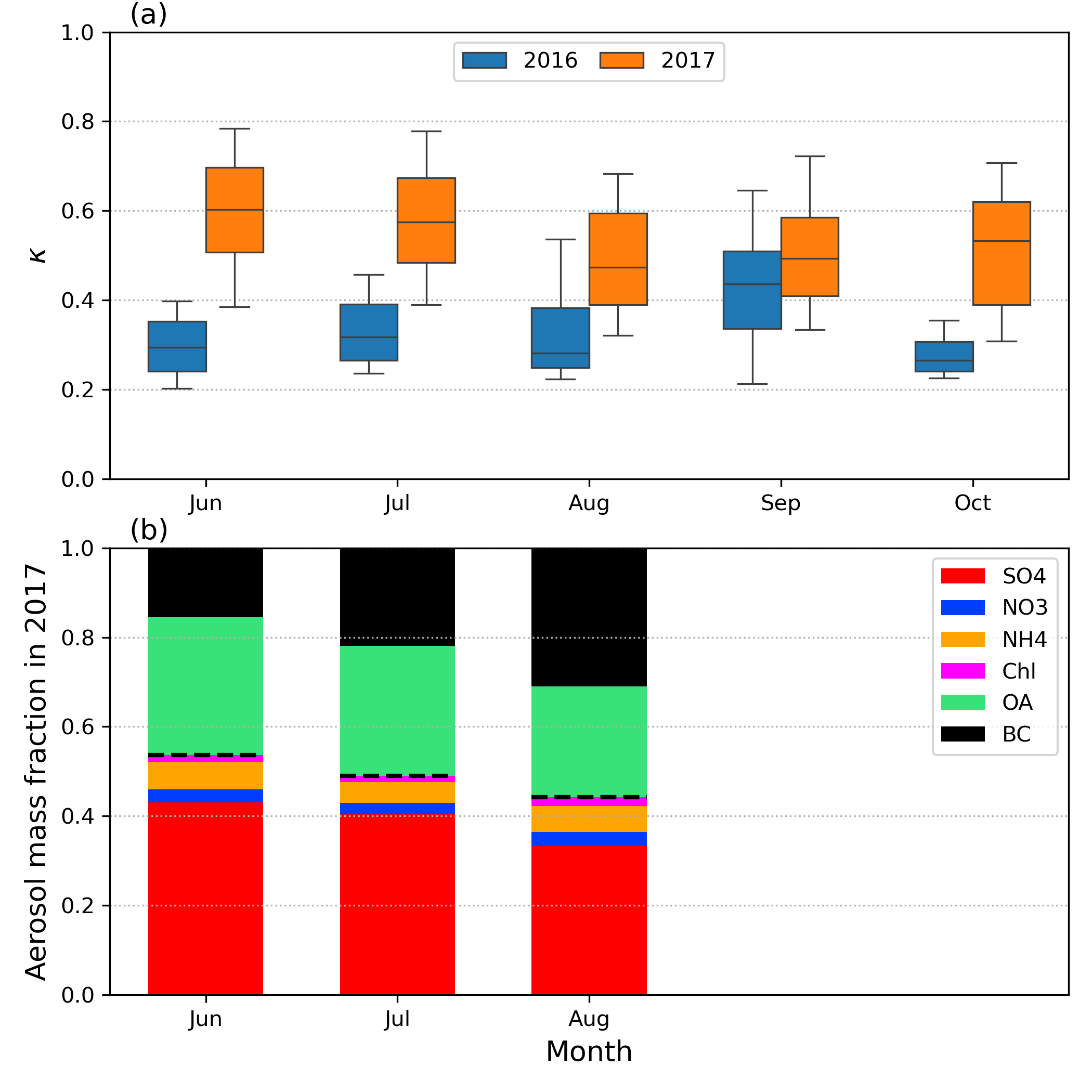
Figure 1(a) Monthly distributions of κ values calculated at 0.1 % supersaturation during the BB seasons of 2016 and 2017. The boxes represent the 25th, 50th (median), and 75th percentiles, while the whiskers extend to the 10th and 90th percentiles. (b) Monthly mean aerosol chemical mass fractions measured by ACSM and SP2 during the 2017 BB season. The black dashed line in (b) represents the separation between inorganic and organic fractions of the aerosol components.(Fig. 1 in Che et al., 2025 )
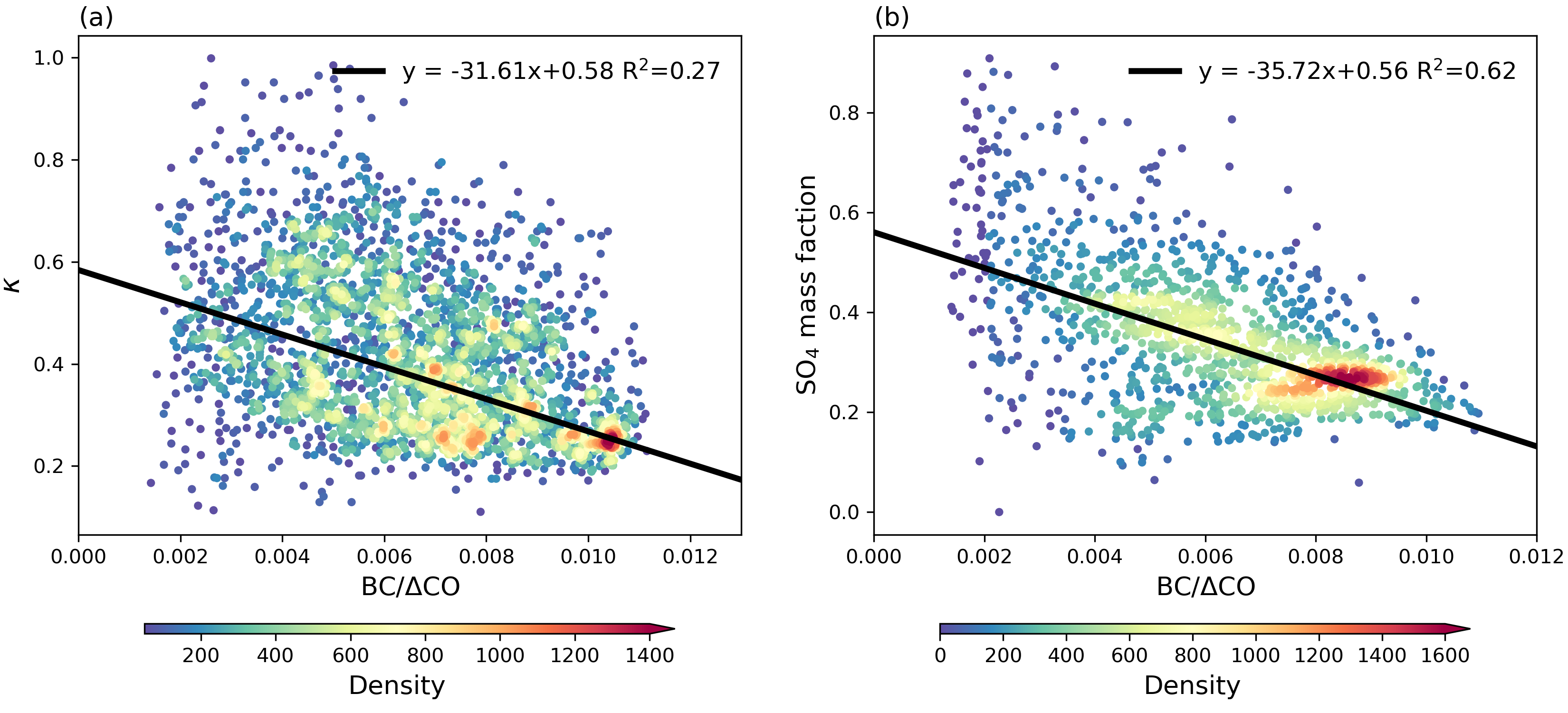
Figure 4Relationships of BC ΔCO with (a) κ calculated at 0.1 % supersaturation and (b) sulfate mass fraction. The black lines represent linear regressions, with the corresponding equations displayed in the legend. The color scale indicates the data density, which is the count of the data in the gridded 50×50 bins of the data range. Note that panel (a) includes data from both the 2016 and 2017 BB seasons, whereas panel (b) only includes data from the 2017 BB season. (Fig. 4 in Che et al., 2025)
This study shows that the way in which fires burn (i.e. whether they burn in smoldering or flaming conditions) and marine emissions have a strong influence on the hygroscopicity of particles measured at Ascension Island during the African biomass burning season.
Impact
These findings highlight that both fire behavior and ocean winds are crucial in shaping how particles interact with clouds. Smoldering fires result in more sulfate in particles, while stronger winds add more sea salt, together making particles more likely to form cloud droplets. Recognizing this dual influence improves our ability to predict how smoke and sea spray jointly regulate cloud formation, rainfall, and the regional climate system over the southeastern Atlantic—an area where cloud cover plays a central role in Earth’s energy balance.
Summary
This work uses in situ observations from the Layered Atlantic Smoke Interactions with Clouds (LASIC) campaign during the 2016 and 2017 African biomass-burning seasons to explore how burning conditions affect aerosol hygroscopicity (κ), a key parameter controlling whether particles can act as cloud condensation nuclei (CCN). The authors find strong month-to-month and year-to-year variations in κ: in 2017, κ averaged ~0.55, much higher than ~0.33 in 2016, meaning particles in 2017 could more readily form cloud droplets. They trace this difference to two main agents: sulfate (from fire emissions) and sea salt. Crucially, fires in 2017 were more dominated by smoldering (lower flame intensity), which favored more sulfate, and at the same time, stronger marine winds boosted sea salt contributions. These compositional shifts underlie the higher hygroscopicity in 2017. The study thus reveals how the interplay between fire combustion state and marine aerosol supply can “tune” aerosol-cloud interactions in the southeastern Atlantic.

Follow Us:






Keep up with the Atmospheric Observer
Updates on ARM news, events, and opportunities delivered to your inbox
ARM User Profile
ARM welcomes users from all institutions and nations. A free ARM user account is needed to access ARM data.