An official website of the United States government





A New Machine Learning Retrieval of Liquid Water Path Optimized for Mixed-Phase Cold-Air Outbreaks
Submitter
Zuidema, Paquita — University of Miami
Area of Research
Cloud Distributions/Characterizations
Journal Reference
Ephraim S, P Zuidema, T Juliano, C Grasmick, M Cadeddu, B Geerts, J French, A Pazmany, and S Woods. 2025. "A New Machine Learning Retrieval of Liquid Water Path Optimized for Mixed-Phase Cold Air Outbreaks Using Radiometer and Radar Observations." Journal of Atmospheric and Oceanic Technology, 10.1175/JTECH-D-24-0132.1.
Science
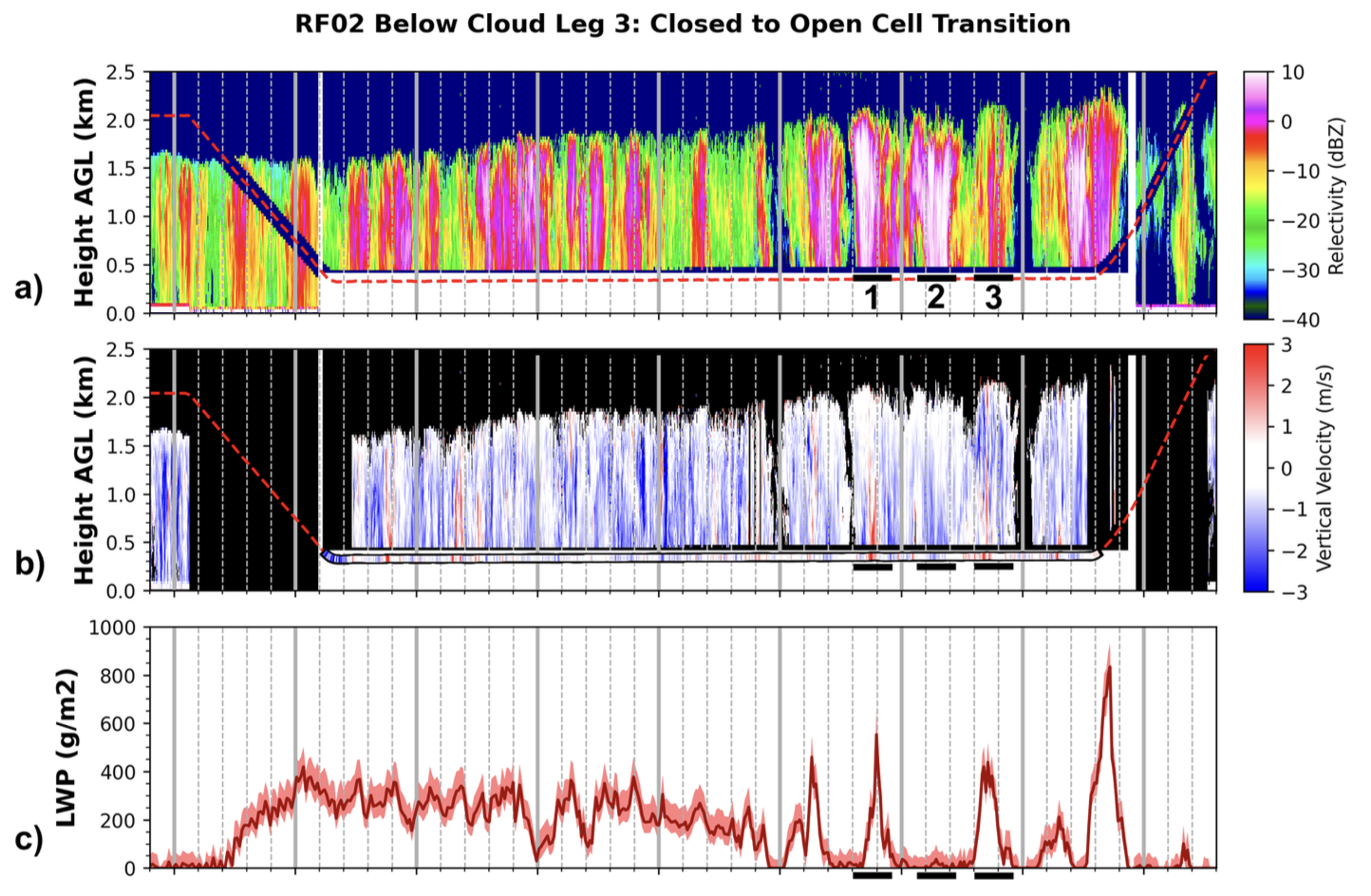
Retrievals from a below-cloud aircraft level leg from 29 Feb 2024 during the NSF CAESAR campaign, across a closed to open-celled transition, with cloud temperatures of ~ -20C. (a) WCR reflectivity and (b) Doppler velocity with in situ vertical velocity included. Plane’s altitude with time indicated with a dotted red line. (c) LWP retrieval. In combination these show how the super-cooled liquid component becomes larger but more inhomogeneous as the clouds transition from stratiform to cumulus, even in these cold conditions.
Cold-air outbreaks over high-latitude oceans typically include mixed-phase clouds and precipitation—in particular supercooled liquid clouds that support snow and graupel through ice growth processes. Here, we present a machine learning approach to retrieve liquid water path (LWP) using passive microwave measurements combined with vertically integrated radar reflectivities. The approach is an extension of Cadeddu et al. (2009), with the novel addition of radar reflectivity. The machine learning models are trained using the Passive and Active Microwave Radiative Transfer (PAMTRA) code applied to output from numerical simulations of three independent cold-air outbreaks sampled during the Cold-Air Outbreaks in the Marine Boundary Layer Experiment (COMBLE) campaign. Brightness temperatures corresponding to the four sidebands of an upward-looking G-band (183 GHz) vapor radiometer, along with the vertically integrated reflectivity from a zenith-pointing 95-GHz Wyoming Cloud Radar, are simulated from the perspective of a near-surface aircraft track. The radar reflectivity helps discriminate the snow contribution to the brightness temperatures. The machine learning models are thereafter tested on a simulation of an independent cold-air outbreak during COMBLE and against measurements from the U.S. Department of Energy (DOE) Atmospheric Radiation Measurement (ARM) North Slope of Alaska (NSA) observatory. This machine learning approach is shown to provide robust, computationally efficient, near-real-time measurements of LWP and water vapor path during the Cold-Air Outbreak Experiment in the Sub-Arctic Region (CAESAR) campaign in February-April 2024.
Impact
The partitioning of the total water into the liquid and ice phases impacts both weather and climate prediction, but accurate measurements on the phase partitioning remain difficult to acquire, especially near–real time.
Summary
Arctic clouds typically include both supercooled liquid and ice within the same column. Their relative amount is important to understand for both weather and climate processes. The retrieval of super-cooled liquid water path (LWP) has not yet been done from aircraft using DOE data to our knowledge. Here, we present a machine learning approach to retrieving LWP using passive microwave measurements combined with vertically integrated radar reflectivities. The approach, based on COMBLE simulations, is shown to be robust, computationally efficient, and applicable in near-real-time.

Follow Us:






Keep up with the Atmospheric Observer
Updates on ARM news, events, and opportunities delivered to your inbox
ARM User Profile
ARM welcomes users from all institutions and nations. A free ARM user account is needed to access ARM data.