An official website of the United States government





Complex Summer Aerosol Regimes and Sources in Houston, Texas
Submitter
Aiken, Allison C
— Los Alamos National Laboratory
Area of Research
Aerosol Properties
Journal Reference
Aiken A, K Benedict, J Lee, K Gorkowski, R Farley, A Meyer, S Jordan, A Md Shawon, and M Dubey. 2025. "Summer Aerosol and Trace Gas Observations in Houston, Texas Using an Adaptable Mobile Facility." Bulletin of the American Meteorological Society, 10.1175/BAMS-D-25-0039.1.
Science
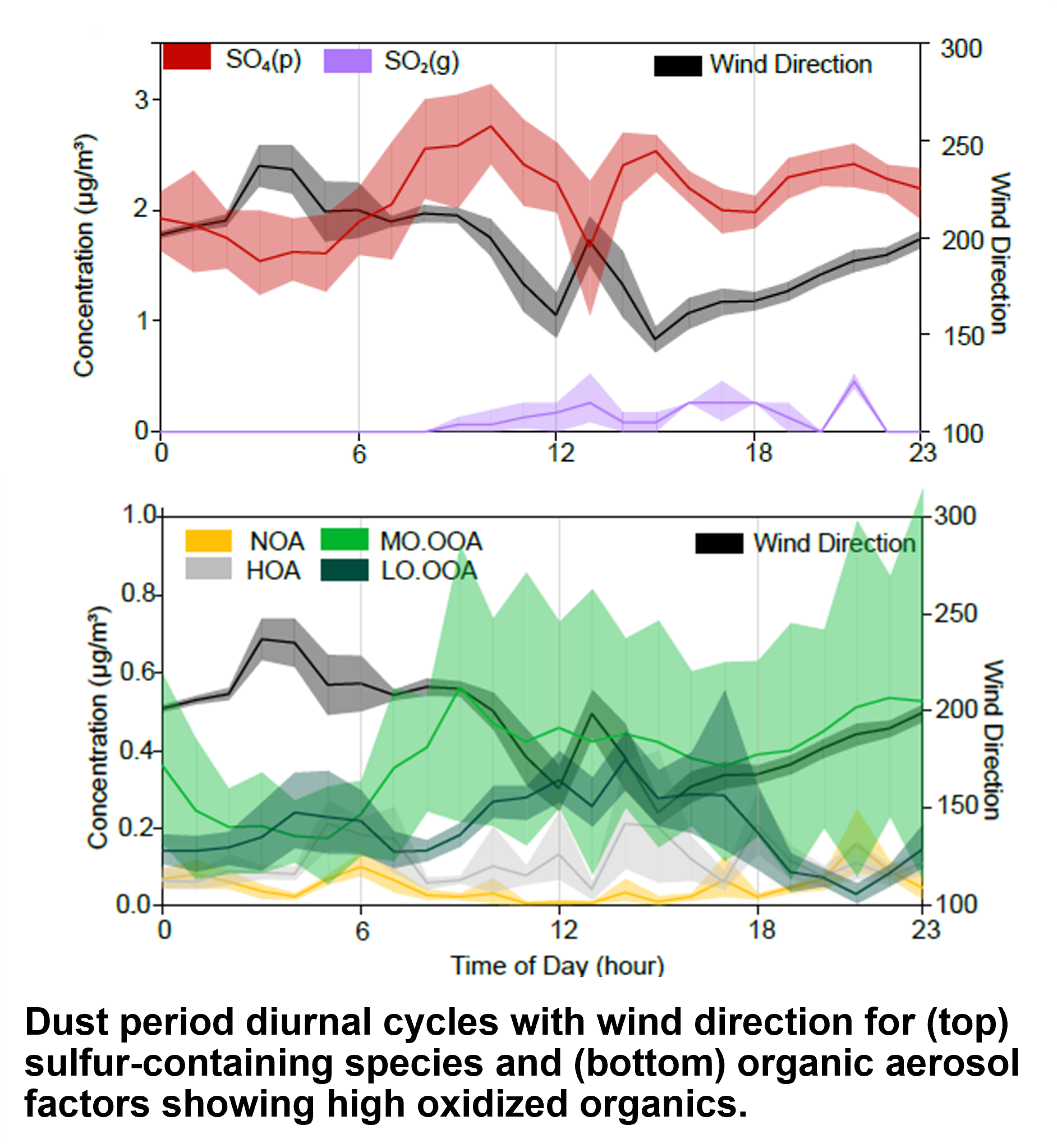
Dust period diurnal cycles with wind direction for (top) sulfur-containing species and (bottom) organic aerosol factors showing high oxidized organics.
Collaborative capabilities were designed to enable unique measurements of aerosol optical properties, water uptake, cloud formation potential, and chemical composition to understand how sources, aging and mixing affect energy within earth systems. Three aerosol regimes were probed in depth during a summer campaign in Houston, Texas: urban, particle growth, and dust.
Impact
Carbonaceous aerosols, sulfur dioxide, physical properties, and water-uptake potential were used to identify different aerosol regimes for urban sources, particle growth, and long-range transported dust events. The study of these materials is crucial to the evolving understanding of water cycles, cloud formation, and energy usage in earth system models.
Summary
During the U.S. DOE Atmospheric Radiation Measurement (ARM) TRacking Aerosol Convection Interactions ExpeRiment (TRACER), a novel field-deployable mobile facility for atmospheric research was used to enable collaborative and customized measurements in July 2022. The adaptable and modular design allowed for the deployment of a core instrument suite and additional customized research-grade instruments to elucidate aerosol physicochemical processes at fine scales. Three aerosol regimes were observed for the complex urban area with multiple local and regional sources and processes that included heterogenous mixtures of particles from urban sources with black carbon, growth events correlated with sulfur dioxide, and transported supermicron dust. Two periods of multi-day long-range transport events of dust from the African Sahara were observed during periods with no precipitation, no aerosol growth events, and with submicron oxidized organics that had increased water-uptake potential. These measurements demonstrated collaborative capabilities to increase observations of aerosol processing, microphysical and optical properties, internal mixing state, and supermicron aerosol that affect terrestrial-atmospheric interfaces and energy balances within the earth system and are not parameterized or are missing in global earth energy system models.

Follow Us:






Keep up with the Atmospheric Observer
Updates on ARM news, events, and opportunities delivered to your inbox
ARM User Profile
ARM welcomes users from all institutions and nations. A free ARM user account is needed to access ARM data.