An official website of the United States government





Regional Testbed Sharpens Aerosol-cloud Science in Earth System Modeling
Submitter
Huang, Meng — Pacific Northwest National Laboratory
Area of Research
Cloud-Aerosol-Precipitation Interactions
Journal Reference
Huang M, P Ma, A Varble, J Fast, T Hassan, J Li, Y Qin, S Tang, P Ullrich, and Y Yao. 2025. "Evaluation of E3SM Simulated Aerosols and Aerosol‐Cloud Interactions Across GCM and Convection‐Permitting Scales." Journal of Advances in Modeling Earth Systems, 17(12), 10.1029/2025MS005288.
Science
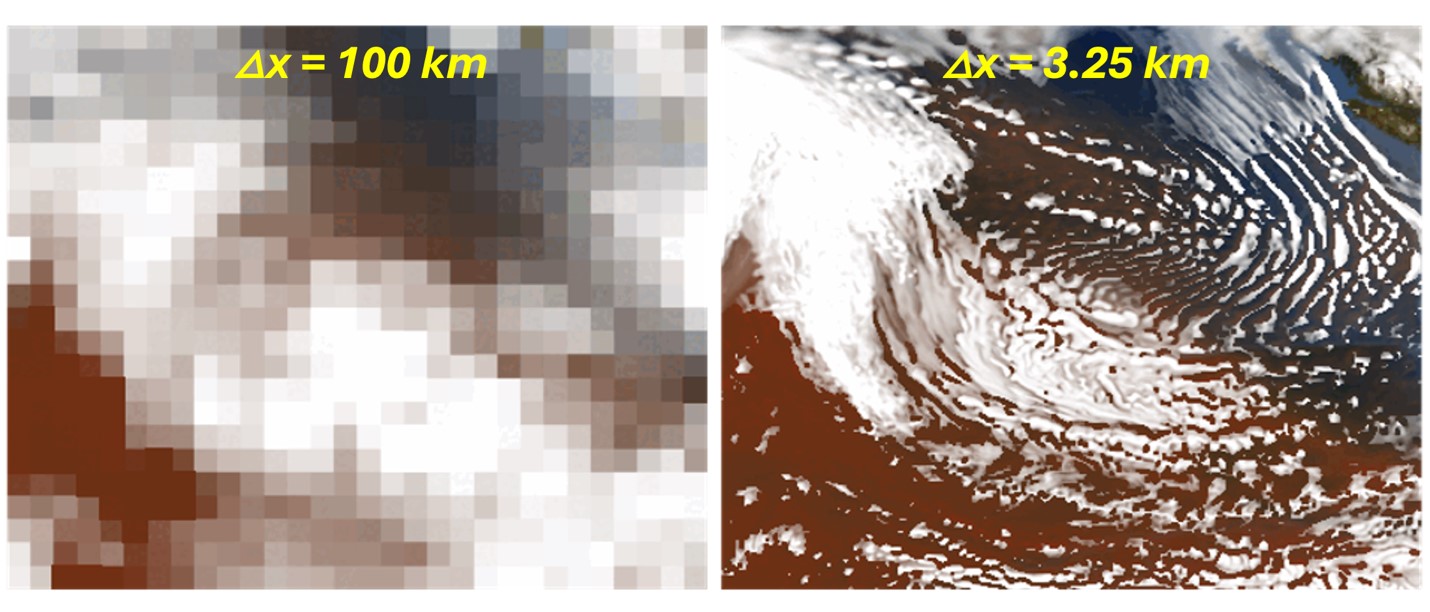
Figure 1. Cloud (white) and aerosol (rust) over the Northeast Pacific Ocean simulated in E3SM with 100-km resolution (left) and 3.25-km resolution (right) demonstrate the improved realism in the aerosol and cloud features with increasing model resolution. Figure provided by authors.
Aerosols influence how clouds form, persist, and reflect sunlight, but their interactions remain one of the largest uncertainties in earth system modeling. Researchers used a regional testbed of the Energy Exascale Earth System Model (E3SM) with regionally refined meshes (RRMs) to explore how kilometer-scale resolution changes the simulation of aerosols and clouds across diverse regions—from the Central United States to the Southern Ocean. Simulations were evaluated against observational data from Atmospheric Radiation Measurement (ARM) User Facility, satellite, and other field campaign and surface measurements. The field campaigns (HI-SCALE, ACE-ENA, CSET, and SOCRATES) supply in situ aerosol and cloud microphysical properties, while satellite and surface observations provide additional constraints on cloud cover, cloud condensate amount, and precipitation.
Convection-permitting RRM improves heavy-rain representation but worsens light-drizzle biases in marine regimes; cloud cover and liquid water path (LWP) agree better with geostationary satellite retrievals, while some surface comparisons favor the coarse-resolution model. For aerosols, kilometer-scale simulations exhibit higher ultrafine aerosol number concentration due to stronger new particle formation (NPF) while reducing accumulation-mode aerosol numbers through more efficient precipitation scavenging over oceans. Increasing resolution also enhances deposition and coagulation in some continental boundary layers. These shifts cut cloud condensation nuclei (CCN) and drive large reductions in cloud-droplet number (Nd), with broader implications for albedo and lifetime effects. Notably, several ACI process relationships improve: the CCN–Nd correlation moderates toward observations, and LWP–Nd behavior is better captured, indicating gains in the realism of ACI coupling even as absolute biases persist. These results reveal how model resolution modifies the processes linking aerosols to clouds and highlight where physical representations must be refined.
Impact
Accurately representing aerosol-cloud interactions is essential for improving Earth system predictions. This study assesses aerosol and ACI in an earth system model running at kilometer-scale resolution, demonstrating where higher resolution pays off and where process representations limit fidelity. Increasing resolution alone is not a universal remedy. This provides a clear path toward accurate earth system simulations at kilometer scales by targeting outstanding biases revealed in the testbed. Improving the accuracy of model representation of aerosol life cycle and ACI is critical, as differences from observations often exceed differences between resolutions, underscoring that unresolved physics dominates prediction errors. The open data and tools now enable scientists to test new microphysics, chemistry, and scavenging schemes using a consistent benchmark framework.
Summary
Researchers developed a regional testbed to evaluate how grid resolution influences aerosol and cloud behavior in the E3SM with varying resolutions. Using a 3.25-km regionally refined E3SM, the testbed reveals that resolution reshapes the aerosol size distribution, producing more ultrafine (Aitken-mode) particles but fewer cloud-relevant accumulation-mode particles, which leads to lower CCN and substantially reduced Nd (often ~50%), larger effective radius, and mixed impacts on biases. Heavy precipitation improves in storm-dominated regions, but marine drizzle biases increase. Cloud cover and LWP comparisons are regime dependent. The most robust benefits appear in ACI metrics as depicted in the CCN–Nd and LWP–Nd relationships, suggesting that kilometer-scale dynamics can better capture these interactive processes even when significant biases remain.
While kilometer-scale grids are necessary, this study shows that it is insufficient to increase prediction fidelity. Despite persistent biases, the finer resolution improved key relationships between CCN, droplet number, and liquid water content, indicating more realistic aerosol-cloud coupling. earth system models must also upgrade their physics representations to accurately simulate aerosol and ACI processes. The openly shared data sets and configuration provide a foundation for testing new physics in E3SM and other earth system models.

Follow Us:






Keep up with the Atmospheric Observer
Updates on ARM news, events, and opportunities delivered to your inbox
ARM User Profile
ARM welcomes users from all institutions and nations. A free ARM user account is needed to access ARM data.