An official website of the United States government



Investigating the Dynamics of Thunderstorm Downdrafts
Submitter
Morrison, Hugh Clifton
— University Corporation for Atmospheric Research
Area of Research
Vertical Velocity
Journal Reference
Hernández Pardo L, H Morrison, and A Possner. 2025. "Dynamics of Downdrafts around a Growing Convective Cloud: A Numerical Study." Journal of Geophysical Research: Atmospheres, 130(22), e2025JD044236, 10.1029/2025JD044236.
Science
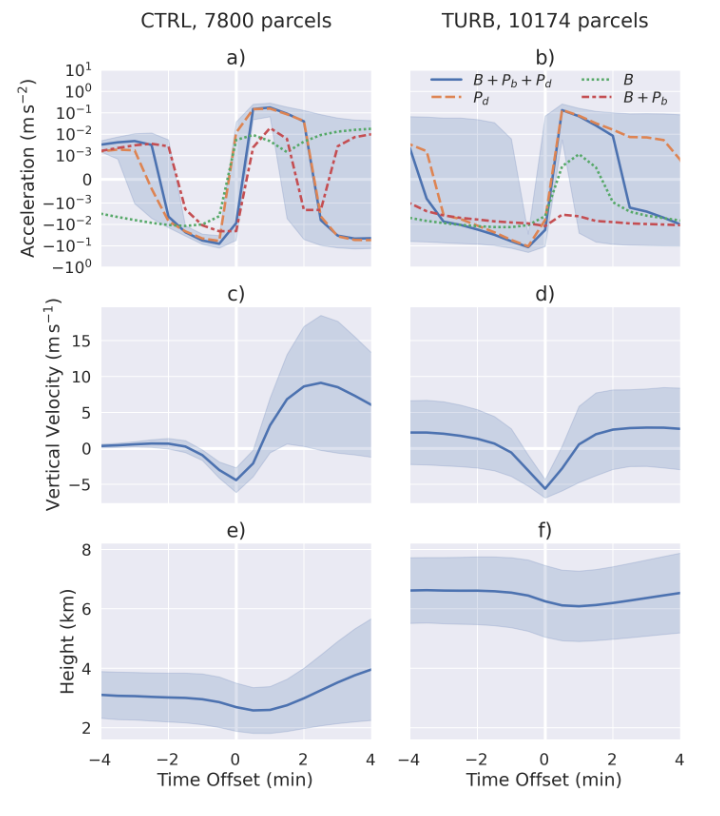
Figure 1. Properties of air parcels from model simulations for parcels that moved through the strong downdrafts: a,b) the various acceleration mechanisms driving parcel vertical motion, c,d) the parcel vertical velocity, e,f) parcel height. The x axes show the time offset of the parcels relative to the time of their minimum vertical velocity. Lines in all plots show parcel averages plus/minus one standard deviation. In a,b) blue is the total acceleration, orange is the dynamic pressure acceleration, green is the buoyancy, and red is the buoyant plus buoyancy pressure acceleration.
Downdrafts, or downward moving currents of air, form around the edges of thunderstorms. They can be an important feature of severe thunderstorms, particularly downbursts, and can be hazardous to aviation as well as drive strong surface winds. More generally, downdrafts are also important for the vertical transport of energy, dry air, and aerosols and chemical constituents in the atmosphere. However, uncertainty about the mechanisms driving downdrafts remains, and this study uses numerical modeling to address this knowledge gap.
Impact
The study focused on downward-moving air currents (downdrafts) around growing thunderstorm clouds using numerical simulations. We characterized how these downdrafts, which are associated with ring-like circulations in the upper part of the clouds, compensate the upward-moving air currents within the cloud core. Our simulations showed that a large fraction (up to 50%) of the upward moving cloud core air is compensated by these downdrafts. The rest of the upward moving cloud core air is compensated by weaker downward motion associated with waves in the environment further away from the cloud. Overall, these results improve the understanding of how downdrafts form in thunderstorm clouds as well as provide guidance for the representation of downdrafts in weather and earth system models.
Summary
In this study, we investigated the downward-moving air around isolated thunderstorm clouds as they grow. Ring-shaped (toroidal) air currents consistently form around the middle and upper portions of these clouds, generating the most intense downdrafts near the cloud edges. In idealized cloud simulations, roughly 10–50% of the cloud’s upward airflow in its core is offset by downward flow within about twice the cloud’s radius. Lower in the cloud, beyond the reach of these toroidal circulations, cloud-edge downdrafts tend to be weaker. By analyzing the forces that propel these downward air motions, we find that they are primarily caused by mechanical forcing associated with the toroidal circulations (Fig. 1). This contrasts with some previous studies that emphasized the role of a negatively buoyant, moist subsiding shell around cumulus clouds in driving downdrafts. Further away from these circulations, weaker downward moving air motion in the environment is associated with propagating waves. This downward motion compensates the remaining fraction of upward moving air in the cloud’s core. Overall, these results improve basic knowledge of the mechanisms of downdraft formation in the upper part of growing thunderstorm clouds as well as provide guidance for the representation of downdrafts in cumulus parameterizations for weather and earth system models.

Follow Us:






Keep up with the Atmospheric Observer
Updates on ARM news, events, and opportunities delivered to your inbox
ARM User Profile
ARM welcomes users from all institutions and nations. A free ARM user account is needed to access ARM data.