An official website of the United States government





The Discovery of Pinned Clouds During TRACER
Submitter
Oktem, Rusen — University of California, Berkeley
Romps, David — University of California, Berkeley
Area of Research
Cloud Processes
Journal Reference
Öktem R, S Giangrande, and D Romps. 2026. "Pinned Clouds over Industrial Sources of Heat during TRACER." Bulletin of the American Meteorological Society, 107(1), 10.1175/BAMS-D-25-0158.1.
Science
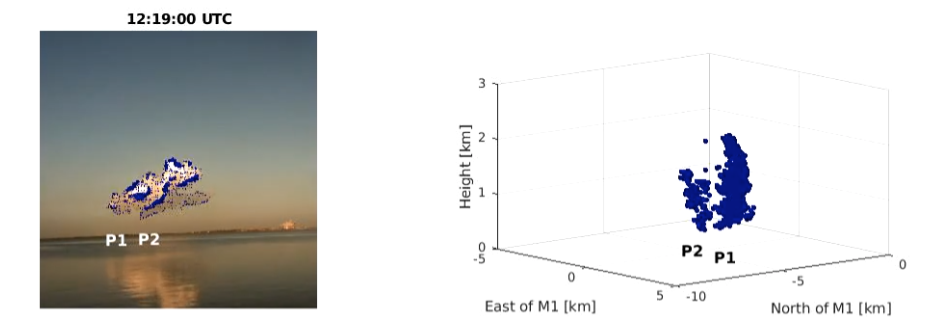
(Left) An example of two pinned clouds generated in the early morning on a day when the atmosphere is on the edge of convective instability. The clouds are pinned to locations P1 and P2, where stacks of two gas-burning plants are concentrated. Blue points are feature points identified by the STEREOCAM system and reconstructed in 3D with reference to the main site (M1).
We analyzed characteristics of pinned clouds, industrial heat sources that trigger them, and the conditions in which they form.
Impact
The statistical steady-state nature of pinned clouds provides a natural setting for exploring the mechanisms controlling convective dynamics, validating convective parameterizations, and studying the models of plume dynamics that simulate the lofting of wildfire smoke.
Summary
During the Tracking Aerosol Convection Interactions Experiment (TRACER), we identified the occasional reoccurrence of steady-state cumuli that persisted by themselves for at least 1h in the time-lapse movies of U.S. Department of Energy Atmospheric Radiation Measurement (ARM) User Facility STEREOCAM instruments. These clouds appeared at or before sunrise, and those mornings transitioned to having widespread shallow moist convection later in the morning. Using stereo reconstruction and atmospheric state measurement data from TRACER instruments, and industrial emissions data from Texas regulators, we confirmed that the waste heat from the stacks of industrial plants provided the nudge needed to initiate and pin the clouds overhead those stacks. Here, we described the characteristics of TRACER’s pinned clouds, and we explained the conditions favoring or inhibiting their formation. These pinned clouds provide an opportunity to test our understanding of the mechanisms controlling convective dynamics, which play a central role in Earth’s atmospheric circulation and radiative balance.

Follow Us:






Keep up with the Atmospheric Observer
Updates on ARM news, events, and opportunities delivered to your inbox
ARM User Profile
ARM welcomes users from all institutions and nations. A free ARM user account is needed to access ARM data.