An official website of the United States government





Removal of Trace Gases Can Both Increase and Decrease Cloud Droplet Formation
Submitter
Petters, Markus D
— University of California, Riverside
Area of Research
Aerosol Properties
Journal Reference
N/A
Science
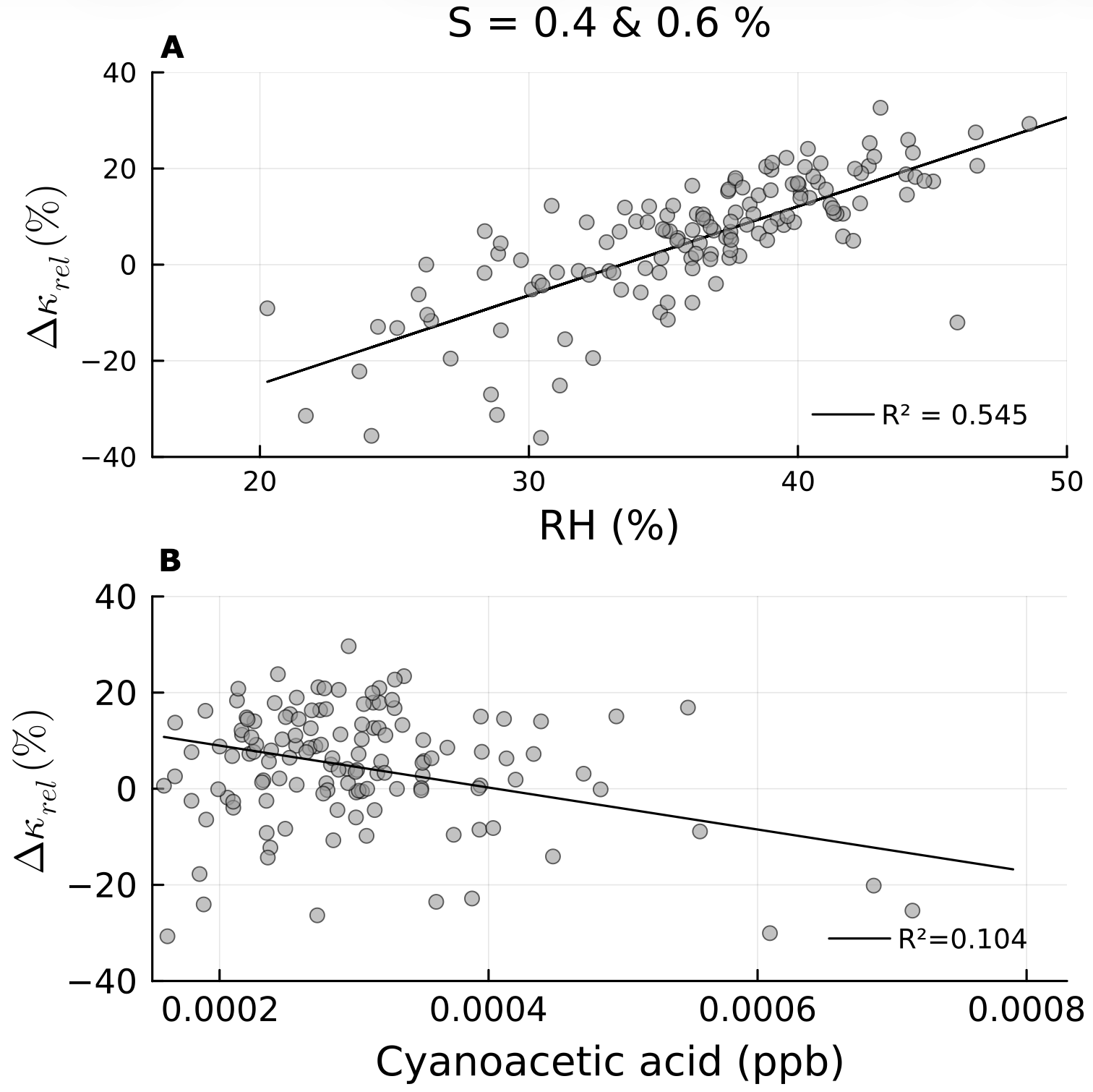
The observed relative difference between the droplet activation expressed as the hygroscopicity parameter with trace gases and with trace gases removed (Δκrel) as a function of relative humidity (A) and cyanoacetic acid concentration (B). Negative Δκrel implies that trace gas removal made it easier to activate the particle into a cloud droplet.
Prior laboratory and modelling studies have indicated that trace gases can affect the critical supersaturation required to activate a particle into a cloud droplet. This study represents the first investigation of the hypothesis that semivolatile trace gases influence cloud condensation nuclei activity in the atmosphere using field observations. To this end, we compared size-resolved activation supersaturation with and without trace gases. Activation supersaturation increased without trace gases when aerosols were wet (size-selected at higher relative humidity). This may be due to loss of semivolatiles by evaporation from the particle phase. Activation supersaturation decreased after removal of trace gases when trace gas concentrations were higher. This may be due to a change in interfacial tension by trace gas adsorption.
Impact
Results from this study indicate that the fundamental mechanism of cloud droplet activation in the presence of semivolatile trace gases remains incompletely understood. The decrease in activation supersaturation after removal suggests that the adsorbed trace gases raise the interfacial tension of the droplet. This study also raises operational questions. If drying aerosol particles to measure their composition can significantly alter some of the semivolatile compounds in the particles, this will create a bias that affects our ability to accurately quantify aerosols’ effects on clouds.
Summary
This study investigated the effect of trace gas removal on size-resolved cloud condensation nuclei activity. Measurements were performed as part of the Atmospheric Radiation Measurement (ARM) User Facility’s Eastern Pacific Cloud Aerosol Precipitation Experiment (EPCAPE) at the site atop Mt. Soledad. The measurements quantified the hygroscopicity parameter κ in the presence and absence of a denuder which removed volatile organic compounds with fewer than 10 carbon atoms from the gas phase. Comparing the hygroscopicity parameter κ with and without the denuder showed that hygroscopicity can both increase or decrease, thus influencing cloud condensation nuclei (CCN) activity through either volatilization or surface adsorption or both. The observed range of changes in κ is surprisingly large when compared to other processes that modify κ under atmospheric conditions. Such changes in κ can correspond to substantial variation in calculated cloud droplet number concentrations. However, the global influence on CCN and droplet number concentration will depend on the concentration and spatial distribution of the trace gas(es) responsible for the perturbation in CCN activity, which remains to be ascertained in future studies.

Follow Us:






Keep up with the Atmospheric Observer
Updates on ARM news, events, and opportunities delivered to your inbox
ARM User Profile
ARM welcomes users from all institutions and nations. A free ARM user account is needed to access ARM data.