An official website of the United States government





ARM Establishes a New Site for Studies of Land–Aerosol–Cloud Interactions in the Southeast U.S.
Submitter
Kuang, Chongai — Brookhaven National Laboratory
Area of Research
Cloud-Aerosol-Precipitation Interactions
Journal Reference
Kuang C, S Giangrande, S Serbin, P Campbell, G Elsaesser, P Gentine, T Heus, N Hickmon, M Oue, J Peters, G Raghunathan, M Ritsche, J Smith, M Spychala, A Steiner, and A Theisen. 2026. "The U.S. DOE ARM User Facility Establishes a New Site for Studies of Land–Aerosol–Cloud Interactions in the Southeastern United States." Bulletin of the American Meteorological Society, 107(1), 10.1175/BAMS-D-25-0072.1.
Science
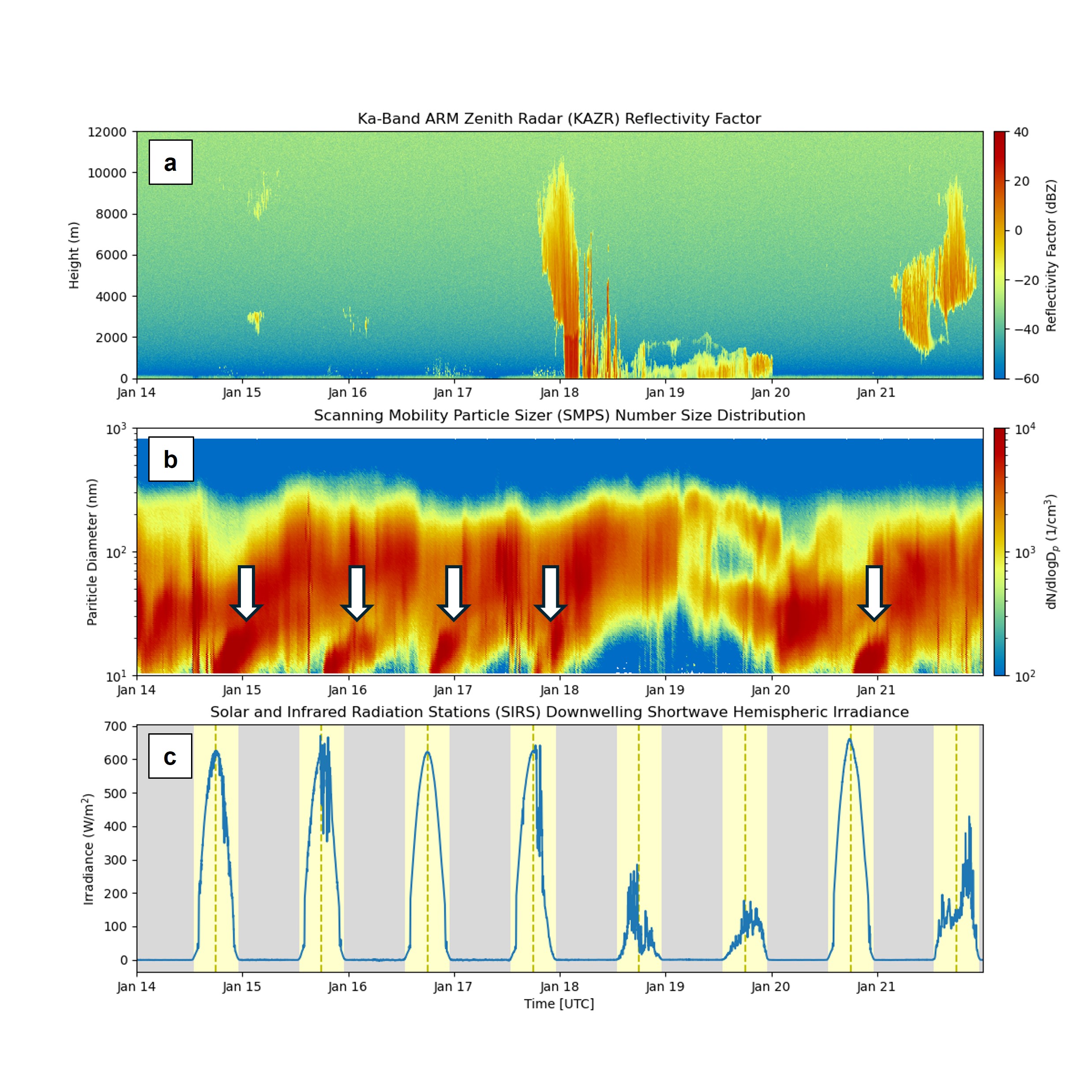
During the week of 14–21 Jan 2025, a data time series of (a) radar reflectivity factor from the KAZR indicating the presence of clouds and precipitation; (b) aerosol number size distribution from the AOS SMPS, with white arrows indicating periods of new particle formation and growth; and (c) broadband shortwave irradiance for downwelling components from the SIRS.
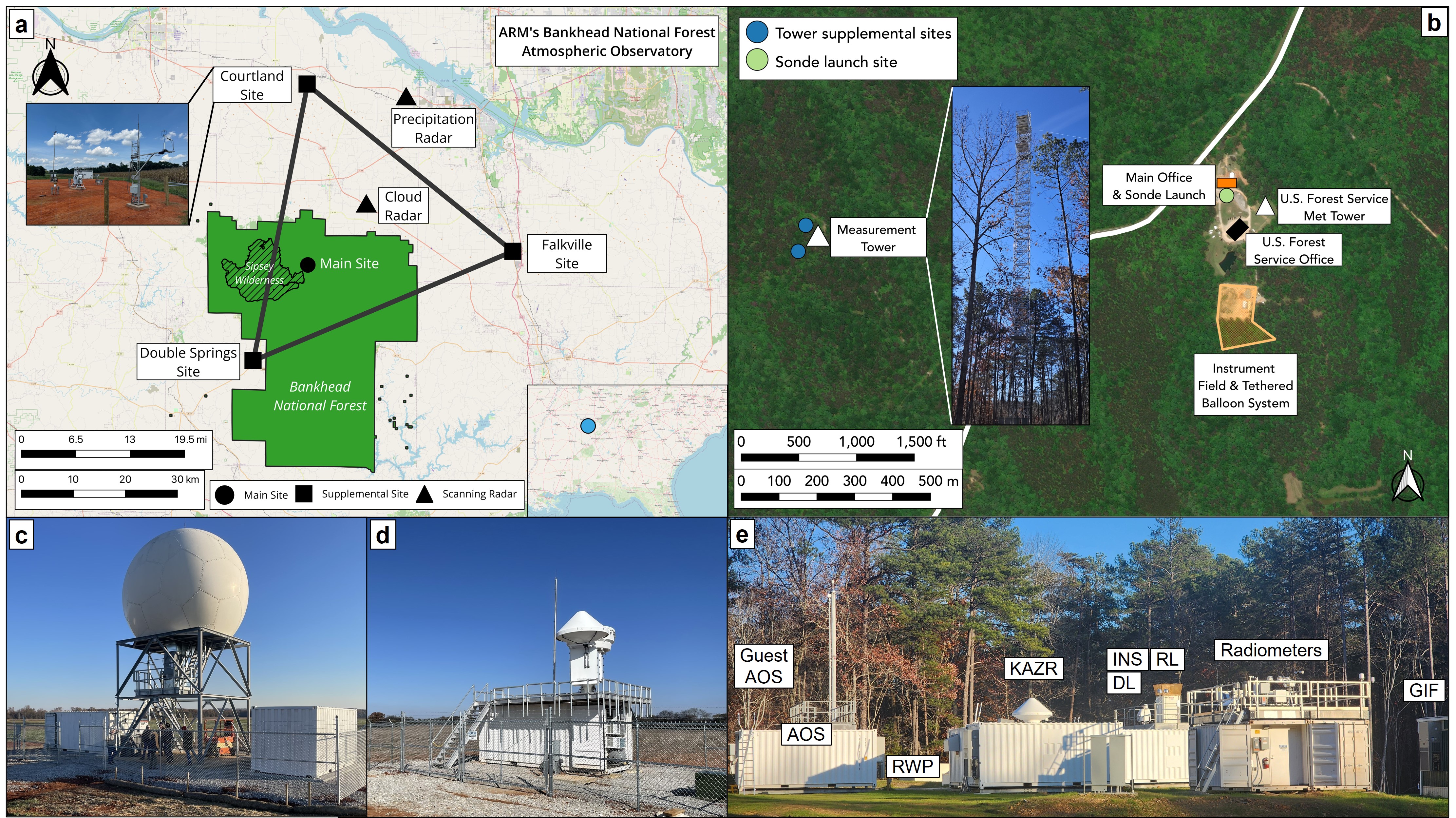
(a) BNF site: location in the N. AL domain, including the Main Site (M1), Cloud and Precipitation Radars, and three supplemental sites at Courtland (inset), Falkville, and Double Springs. (b) M1: location in the U.S. Forest Service (USFS) Black Warrior Work Center, including the 43-m walk-up measurement tower (inset), main office, USFS office, instrument field and Tethered Balloon System hangar. (c) C-band scanning ARM Precipitation Radar. (d) Ka/X-band scanning ARM Cloud Radar. (e) The M1 instrument field, including the Aerosol Observing System (AOS) and Guest AOS, Radar Wind Profiler (RWP), Ka-band ARM Zenith Radar (KAZR2), ice-nucleating spectrometer (INS), Doppler lidar (DL), Raman lidar (RL), radiometers, and the Guest Instrument Facility (GIF). Figure courtesy of Shawn Serbin (NASA GSFC), Patty Campbell (ANL), and Mark Spychala (ANL).
The U.S. Department of Energy (DOE) Atmospheric Radiation Measurement (ARM) User Facility has launched a new multi-year observational site in the Bankhead National Forest (BNF) in northern Alabama, a region characterized by abundant biogenic aerosol, frequent convection, and strong land-atmosphere coupling. This site has an extensive suite of advanced instruments—including ground-based aerosol sensors, atmospheric profilers, scanning cloud and precipitation radars, elevated tower measurements, and aerial platforms—designed to capture observations from the forest canopy up through the clouds. These detailed observations will reveal how the forest influences the aerosol population, the land surface regulates the transition from shallow-to-deep convection, and vegetation controls energy and turbulence within the boundary layer.
Impact
The ARM BNF site is strategically sited within a region frequently impacted by phenomena that present significant risks to U.S. energy production and distribution, including severe weather, wildfire emissions, drought, and persistent heatwaves with high humidity. These high-risk phenomena are strongly influenced by the land-aerosol-cloud interactions that the BNF site was carefully designed and instrumented to study. The BNF site will provide observations, support analyses, and help develop the coupled modeling-observation frameworks needed to accelerate the improvement of how these processes are represented in earth system models.
Summary
The DOE ARM User Facility has established a new site in the BNF that will gather data on how clouds, the land surface, and aerosols interact at a hierarchy of scales important to understanding and simulating the Earth system. Starting its operations in October 2024, the BNF site provides a multiyear opportunity for scientists to unravel complex land–atmosphere interactions. A suite of ground-based sensors, elevated tower-based instrumentation, and aerial facilities will enable scientists to investigate those interactions from within the canopy to the clouds. The southeastern United States was recommended by the DOE ARM User Facility and its collaborators in the broader community as an important region to address their common scientific questions, given the region’s abundant surface-forced convective clouds and mesoscale convective systems that pose ongoing challenges in earth system models. The region is also home to significant terrain complexity and land-use heterogeneity that will unleash new understanding of anthropogenic and biogenic aerosol processes, boundary layer aerosol–cloud interactions, and the interactions between the terrestrial ecosystem and coupled aerosol–cloud–radiation processes.

Follow Us:






Keep up with the Atmospheric Observer
Updates on ARM news, events, and opportunities delivered to your inbox
ARM User Profile
ARM welcomes users from all institutions and nations. A free ARM user account is needed to access ARM data.