An official website of the United States government





Dampening of the Precipitation Susceptibility to Aerosols from Cloud Turbulence
Submitter
Morrison, Hugh Clifton
— University Corporation for Atmospheric Research
Area of Research
Cloud-Aerosol-Precipitation Interactions
Journal Reference
Chandrakar K and H Morrison 2025. "Dampening of the Precipitation Response to Aerosol Pollution from Turbulence in Cumulus Clouds." Geophysical Research Letters, 52(23), e2025GL118693, 10.1029/2025GL118693.
Science
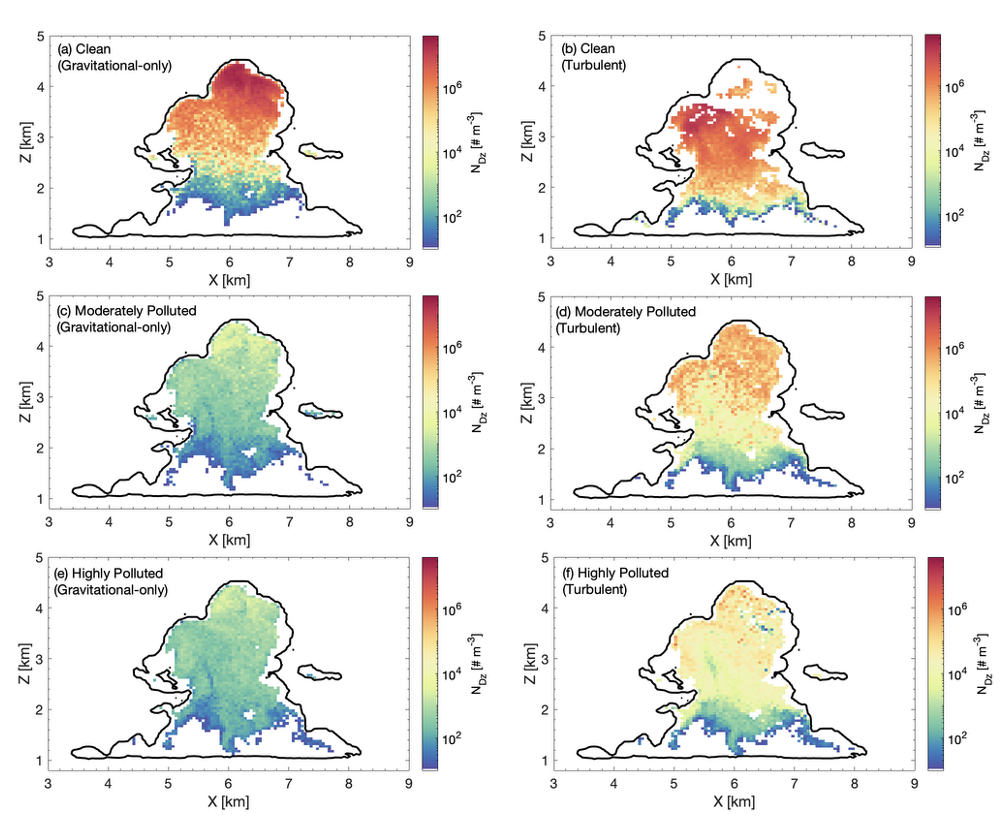
Figure 2 Vertical cross sections of the drizzle embryo number concentrations under different aerosol conditions with and without turbulent effects on coalescence. Black contours represent the cloud boundaries.
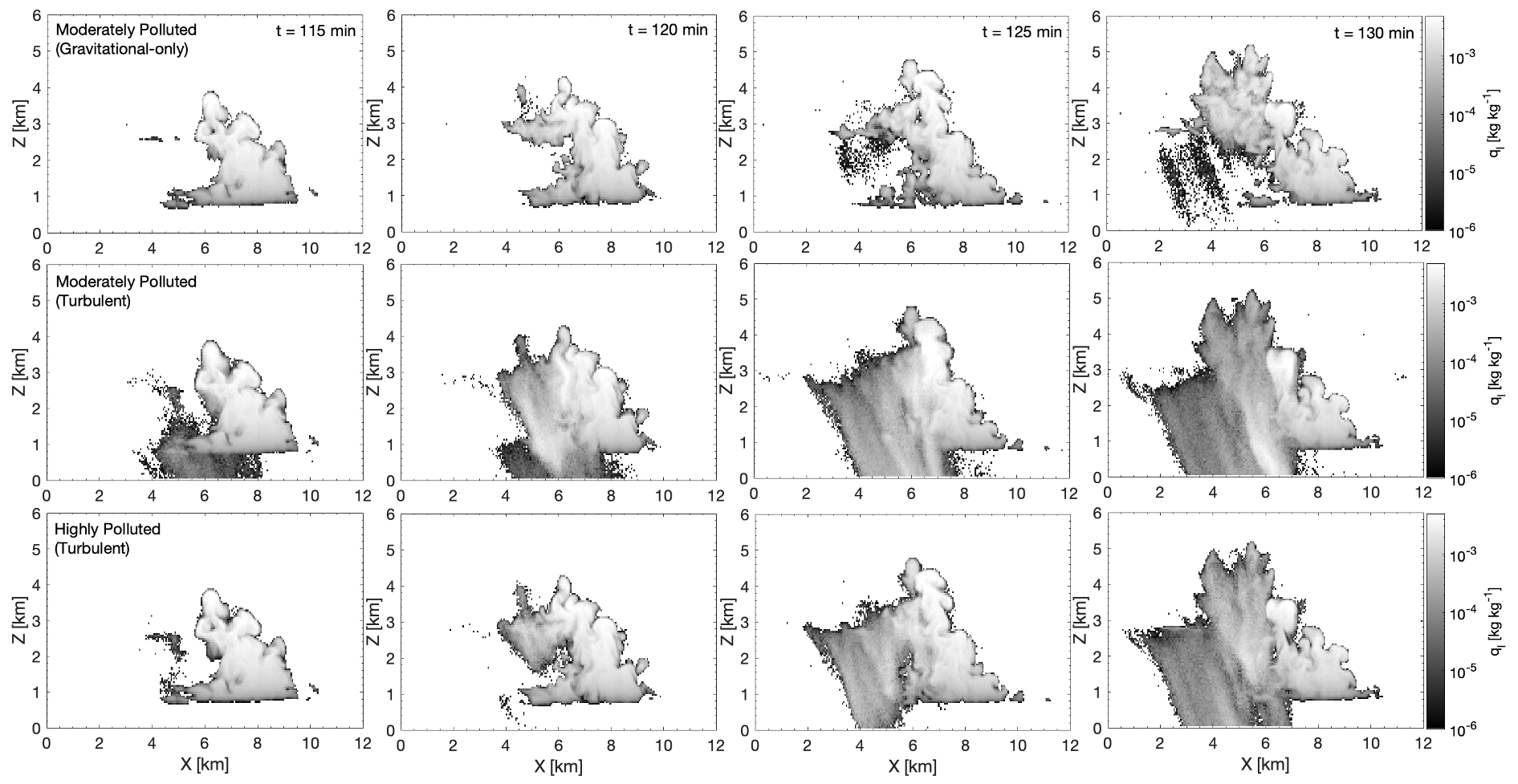
Figure 1 Time evolution of vertical cross‐sections of the liquid water field from simulations of a moderately polluted case with gravitational‐only coalescence (first row) and with turbulent effects on drop coalescence (second row). For comparison, the third row shows a highly polluted case with turbulent drop coalescence.
Warm rain formation is a critical factor for cloud modulation and the response of precipitation to aerosol loading. However, it remains challenging to accurately represent in atmospheric models across scales because the driving process, droplet collision-coalescence, involves interactions at micro‐scales that interact with larger scales. The current study, using observations and a state-of-the-art cloud model, investigates the role of small-scale turbulence in modulating the precipitation response to aerosol loading through drop coalescence.
Impact
Using aircraft observations and a detailed cloud model with a state-of-the-art particle-based representation of cloud droplets, it is shown that the enhancement of drop collision-coalescence from turbulent flow in clouds not only leads to earlier onset of rain in warm cumulus clouds as past studies have suggested, but also significantly dampens the response of precipitation to aerosol loading. Overall, turbulence-enhanced drop coalescence strongly influences the response of warm cumulus clouds and precipitation to aerosol loading, suggesting that the effects of turbulent coalescence should be included in earth system model representations of aerosol-cloud-precipitation interactions and aerosol indirect radiative forcing.
Summary
The warm rain response to aerosol pollution is a critical problem that remains challenging in earth system models. A key aspect is the fundamental knowledge gap concerning the extent of the influence of cloud turbulence on aerosol‐cloud‐precipitation interactions. In this study, we use a state-of-the-art modeling framework, combined with thermodynamic, aerosol, and cloud observations, to examine the precipitation response to increased aerosol concentration in cumulus clouds. The large-eddy simulation model with a sophisticated particle-based microphysics scheme is used to simulate observationally based cases of cumulus congestus clouds. We analyzed simulations under five background aerosol conditions, from clean to highly polluted, and two thermodynamic and wind shear environments. The enhancement of drop collision-coalescence from turbulent flow in clouds not only leads to earlier onset of rain in warm cumulus clouds but also significantly dampens precipitation susceptibility to aerosol loading (see Fig. 1). This study also found that turbulent enhancement of drop coalescence strongly impacts the production of drizzle embryos, leading to substantial drizzle embryo concentrations even in highly polluted conditions (see Fig. 2). Without turbulence effects on coalescence, the production of drizzle embryos is limited in moderately to highly polluted conditions, and significant drizzle embryo concentrations occur only in clean conditions for these cumulus congestus cases. These differences in drizzle embryo production between the turbulent and gravitational-only coalescence kernels profoundly affect precipitation susceptibility to aerosols. Overall, these results suggest that the effects of turbulent coalescence should be included in earth system models, which currently parameterize cloud‐to‐rain conversion based on gravitational‐only coalescence.

Follow Us:






Keep up with the Atmospheric Observer
Updates on ARM news, events, and opportunities delivered to your inbox
ARM User Profile
ARM welcomes users from all institutions and nations. A free ARM user account is needed to access ARM data.