An official website of the United States government





New Insights into Aerosol-cloud Interaction Over the Eastern North Atlantic
Submitter
Feng, Yan — Argonne National Laboratory
Area of Research
Cloud-Aerosol-Precipitation Interactions
Journal Reference
Zheng X, Y Feng, D Painemal, M Zhang, S Xie, Z Li, R Jacob, and B Lusch. 2025. "Regime-based aerosol–cloud interactions from CALIPSO-MODIS and the Energy Exascale Earth System Model version 2 (E3SMv2) over the Eastern North Atlantic." Atmospheric Chemistry and Physics, 25(23), 10.5194/acp-25-17473-2025.
Science
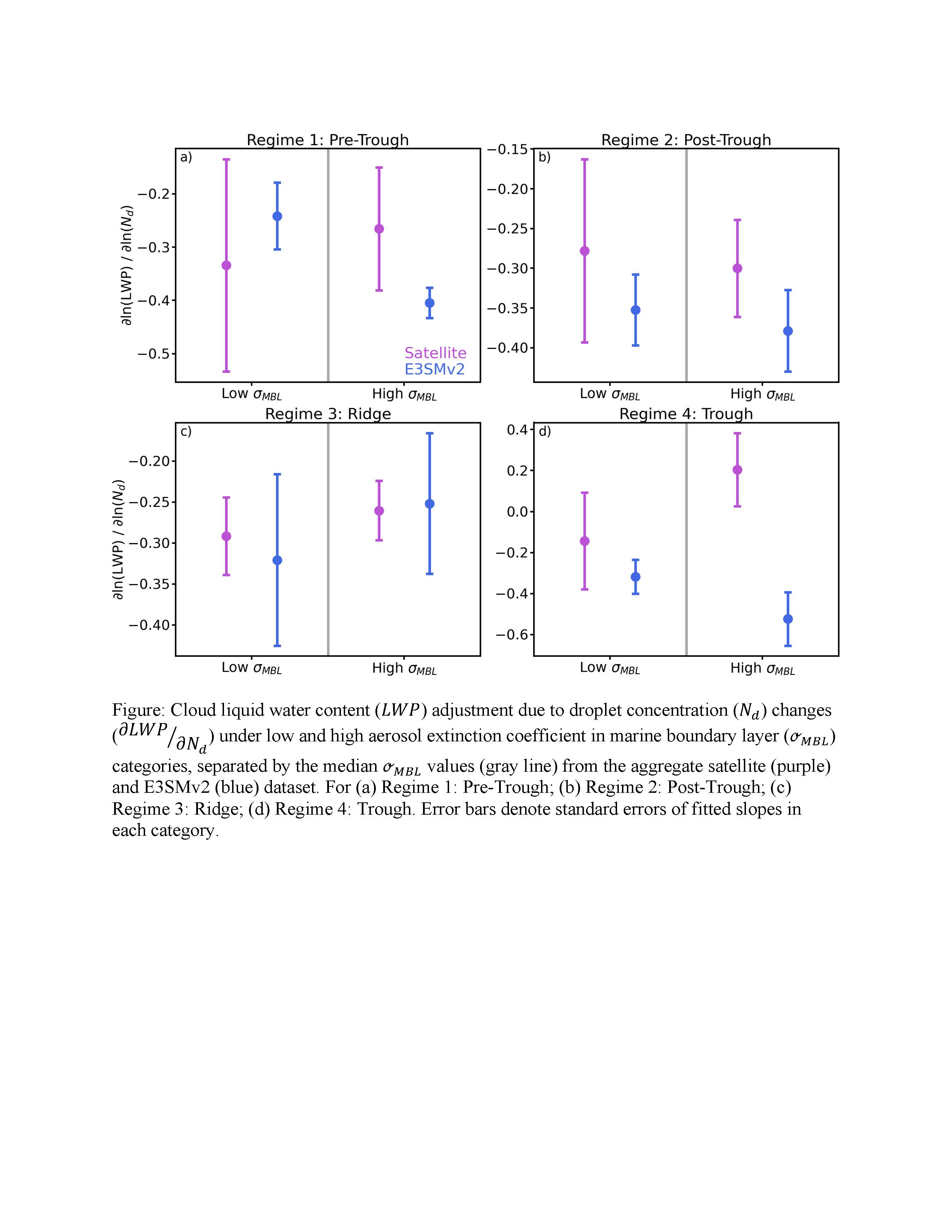
Cloud liquid water content (LWP) adjustment due to droplet concentration (Nd) changes under low and high aerosol extinction coefficient in marine boundary layer categories, separated by the median values (gray line) from the aggregate satellite (purple) and E3SMv2 (blue) dataset. For (a) Regime 1: Pre-Trough; (b) Regime 2: Post-Trough; (c) Regime 3: Ridge; (d) Regime 4: Trough. Error bars denote standard errors of fitted slopes in each category.
While a non-monotonic (“inverted-V”) cloud response to aerosol perturbation—initial cloud thickening via precipitation suppression followed by enhanced evaporative dissipation—has been previously reported, its meteorological conditioning remains unresolved. Using a deep-learning framework to objectively classify Eastern North Atlantic synoptic regimes, we show that the cloud response is strongly regime-dependent and that the U.S. Department of Energy's earth system model (E3SMv2) systematically overestimates liquid water loss, particularly in dynamically complex, precipitating environments with strong vertical motion. These biases are linked to uncertainties in models representing drizzle, entrainment, and turbulent processes.
Impact
By identifying regime-dependent deficiencies in cloud microphysics and turbulence parameterizations, this work provides a targeted pathway for improving the earth system model fidelity. Reducing these biases will enhance projections of cloud feedback, precipitation variability, and severe weather intensity—key uncertainties in future seasonal-to-decadal and global water-cycle predictions.
Summary
This study advances our understanding of how aerosols influence marine clouds by comparing satellite observations from the Cloud-Aerosol Lidar and Infrared Pathfinder Satellite Observation (CALIPSO) and the Moderate Resolution Imaging Spectroradiometer (MODIS) with simulations from the E3SMv2 model. Using a deep-learning framework, we identified four distinct weather patterns (Pre-Trough, Post-Trough, Ridge, and Trough) over the Eastern North Atlantic to isolate how large-scale meteorology modulates aerosol–cloud interactions. Both observations and E3SMv2 exhibit an inverted-V relationship between liquid water path and cloud droplet concentration, confirming that aerosols initially increase cloud water by suppressing precipitation, but at higher concentrations promote cloud thinning through enhanced evaporation and entrainment of dry air. However, E3SMv2 systematically overestimates cloud sensitivity to aerosol changes across regimes (Figure). While the model captures stable cloud decks (Ridge) reasonably well, its performance degrades in dynamically active storm systems (Trough), where it removes cloud water too rapidly. These biases are linked to limitations in the model’s cloud microphysics and turbulence parameterizations, which struggle to represent the delicate balance between drizzle formation and turbulent mixing. By identifying these regime-specific deficiencies, this study provides a pathway for refining model physics and improving predictions of the global water cycle and severe weather intensity.

Follow Us:






Keep up with the Atmospheric Observer
Updates on ARM news, events, and opportunities delivered to your inbox
ARM User Profile
ARM welcomes users from all institutions and nations. A free ARM user account is needed to access ARM data.