An official website of the United States government





Optimizing Cloud Droplet Sampling with Pumped Counterflow Virtual Impactors
Submitter
Mazzoleni, Claudio — Michigan Technological University
Area of Research
Aerosol Processes
Journal Reference
Joshi S, G Kulkarni, L Mazzoleni, W Cantrell, R Shaw, S Schum, T Divisekara, I Helman, I Norwood, J Nordeng, J Anderson, K Gorkowski, T Onasch, A Sedlacek, O Enekwizu, and C Mazzoleni. 2026. "Performance of pumped counterflow virtual impactors to study aerosol interactions with laboratory generated warm clouds." Aerosol Science and Technology, 10.1080/02786826.2026.2615760.
Science
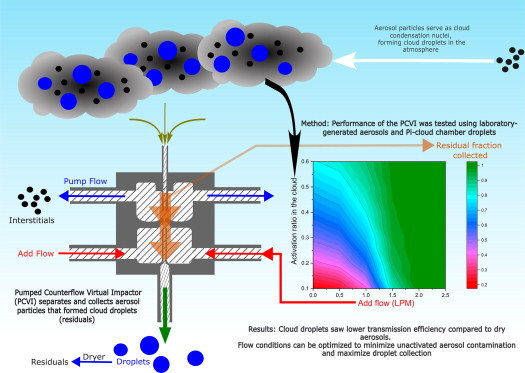
Graphical abstract
Atmospheric particles act as nuclei for the formation of cloud droplets. To study these nucleation processes, pumped counterflow virtual impactors are often used because they can separate cloud droplets or ice crystals from inactivated particles. In this study, we compared the performances of three commercial units in a laboratory setting using dry aerosols and cloud droplets. We quantified how the transmission efficiency varies with flow rates and particle types, and identified the operating conditions that optimize the collection of activated particles.
Impact
The study provides a practical framework for selecting the optimal flow settings in pumped counterflow virtual impactors. Such settings can be used to maximize the collection of cloud residuals (particles that nucleate cloud droplets) for different cloud activation ratios. The study also establishes standardized testing and alignment procedures that reduce unit-to-unit variability. The findings can improve the reliability of future cloud-aerosol interaction studies and the representation of these processes in climate and weather models.
Summary
To understand the interactions between atmospheric particles and clouds, we need to be able to separate particles that form cloud droplets or ice crystals (residuals) from those that are not in cloud droplets (interstitials) at the time of collection. Pumped Counterflow Virtual Impactors (PCVIs) are commonly used to isolate droplets or ice crystals from interstitial particles. The effectiveness of the collection of residuals is quantified by the transmission efficiency (TE). For warm clouds, TE is defined as the ratio of the droplet number concentration at the inlet of the PCVI to that at the outlet after accounting for the PCVIs concentrating factor. Previously reported TE values vary considerably across studies and are typically reported for ice residuals or dry particles, while little quantitative data exists for cloud droplets.
In our study, we compared three commercial PCVI units under identical laboratory conditions using sodium chloride particles, 3 µm polystyrene latex spheres, kaolinite dust, and cloud droplets generated in the Michigan Tech Pi-Chamber. All three units effectively rejected submicron particles (≤1% TE at 1.5 LPM add flow). For supermicron dry aerosols, TEs reached 40–60%, while cloud droplet TEs were substantially lower (8–16%). The difference was attributed to water’s lower density, droplet losses, and water accumulation inside the PCVI. One unit initially exhibited reduced performance due to a small misalignment of the inlet orifice. A custom alignment insert restored the TE to levels comparable to the other units. A residual-fraction framework was developed showing that even for low cloud activation ratios (1:10), add flows of 1.5 LPM yield greater than 80% residual separation. The study provides PCVI flow settings and recommendations to optimize the TEs for future laboratory and field cloud-residual studies.

Follow Us:






Keep up with the Atmospheric Observer
Updates on ARM news, events, and opportunities delivered to your inbox
ARM User Profile
ARM welcomes users from all institutions and nations. A free ARM user account is needed to access ARM data.