An official website of the United States government





Aerosol Influences on Cloud Water: Insights from EPCAPE Data with Explainable Machine Learning
Submitter
Zhang, Yunyan — Lawrence Livermore National Laboratory
Zhang, Haipeng — University of Maryland, College Park
Area of Research
Cloud-Aerosol-Precipitation Interactions
Journal Reference
Zhang H, Y Zhang, Z Li, and Y Zheng. 2025. "Aerosol Influences on Cloud Water: Insights from ARM EPCAPE Observations with Explainable Machine Learning." Geophysical Research Letters, 52(15), e2025GL115163, 10.1029/2025GL115163.
Science
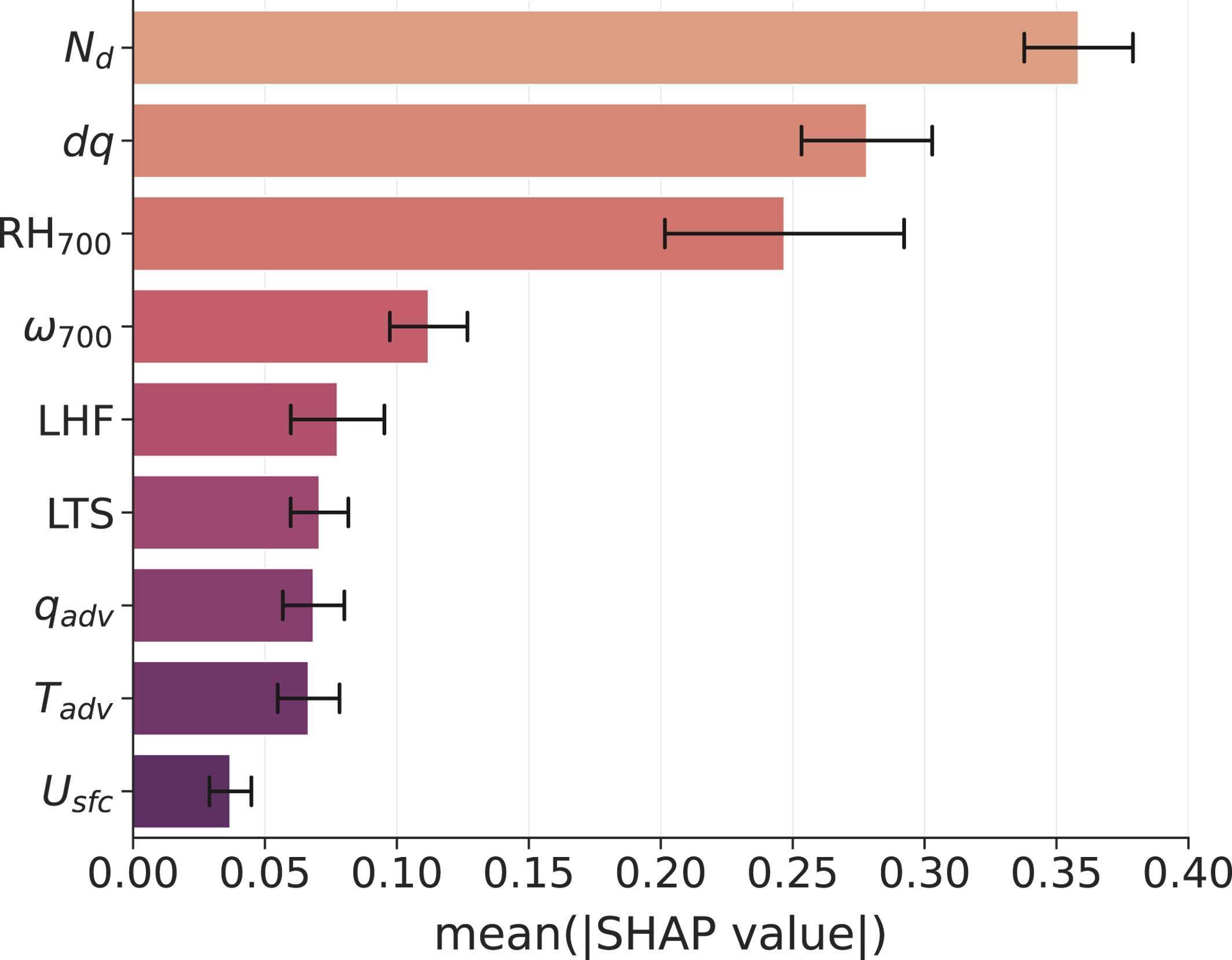
Bar plot of each predictor's absolute SHapley Additive exPlanations (SHAP) values averaged over cases and ensemble members by XGBoost, normalized by the mean liquid water (LWP) path. Error bars indicate the standard deviation of the above SHAP values derived from 100 ensemble members.
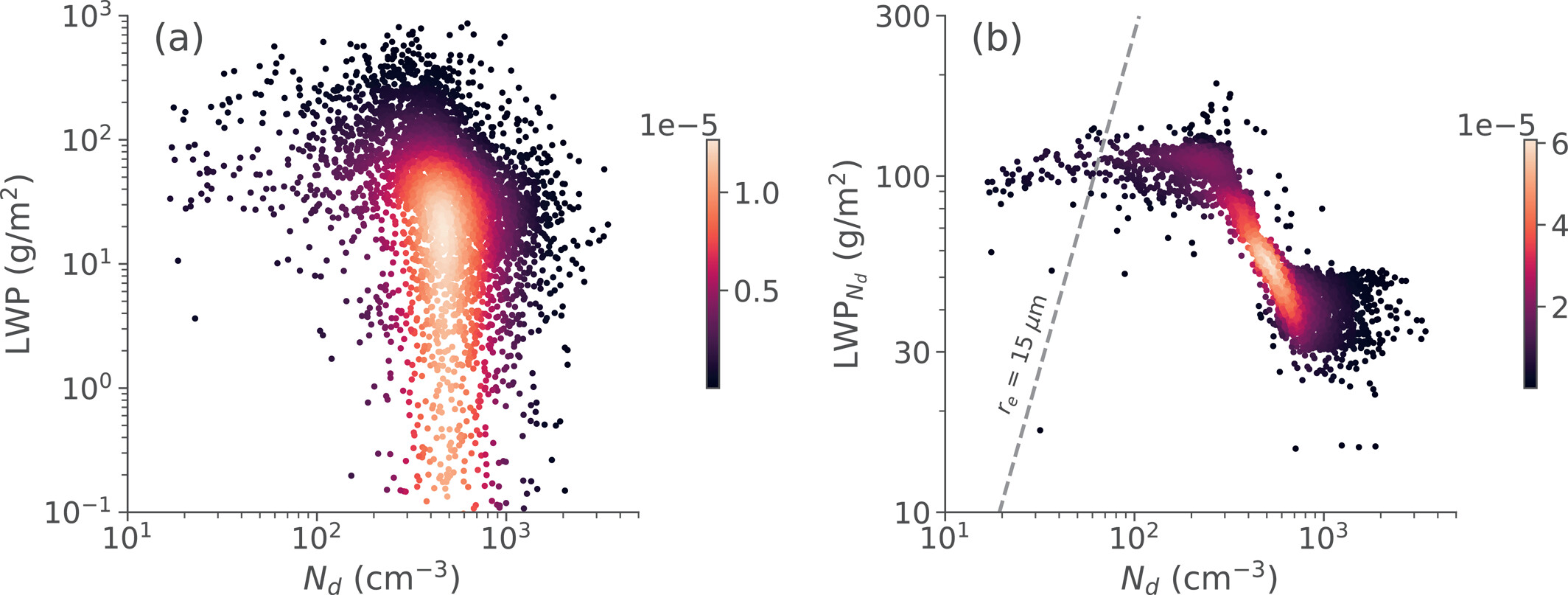
Relationship between hourly LWP and Nd derived from Eastern Pacific Cloud Aerosol Precipitation Experiment (EPCAPE) observations. (a) The relationship when aerosol effects on LWP are co-influenced by large-scale meteorological factors like large-scale vertical velocity, surface winds, etc. (b) The relationship after removing meteorological effects using the SHAP analysis. The color bar indicates scatter density, and the dashed line in panel (b) represents the 15-μm cloud top effective droplet radius.
Aerosol-cloud interactions remain one of the largest uncertainties in physical process understanding and long-term projections. A key challenge is disentangling causality in observed aerosol-cloud relationships, as both variables can be independently influenced by large-scale meteorology. To address this, we apply an explainable machine learning (ML) framework to isolate and examine the individual effects of aerosols and meteorological factors (MFs) on cloud liquid water path (LWP), using recent observations from the Eastern Pacific Cloud Aerosol Precipitation Experiment (EPCAPE) field campaign conducted by the Atmospheric Radiation Measurement (ARM) User Facility.
Impact
Through our explainable ML approach, aerosol effects are isolated, revealing that the negative response of cloud water to aerosols is more likely due to the causal mechanism of entrainment drying, rather than by covariance induced by synoptic‐scale meteorology. These findings demonstrate the capability of explainable ML to disentangle complex aerosol‐cloud interactions and offer valuable insights for constraining and refining warm‐cloud microphysics parameterizations in future research.
Summary
This study adopts recent ARM EPCAPE observations and explainable ML approaches—XGBoost with SHapley Additive exPlanations (SHAP) analysis—to explore the relationship between cloud water and aerosols. The SHAP analysis, based on coalitional game theory, quantifies the individual contribution of a predictor by computing the change in XGBoost-predicted LWP when that predictor is removed, averaged over all possible predictor combinations. Results show aerosols predominantly explain the LWP variability compared to each key MF in EPCAPE observations. By excluding meteorological influences, a significant negative linear relationship is found between LWP and cloud droplet number concentrations (Nd), consistent with the negative regime (right branch) of the inverted‐V relationship reported in previous studies. This negative response is more likely attributed to entrainment drying, rather than meteorology-induced covariance, particularly the airmass‐history argument. Furthermore, the sensitivity of LWP to aerosols exhibits a non‐linear dependence on MFs such as the moisture contrast between surface and free troposphere and lower‐tropospheric stability. This dependence arises from the interplay between the direct effects of MFs on entrainment drying and their indirect influence via LWP adjustments.

Follow Us:






Keep up with the Atmospheric Observer
Updates on ARM news, events, and opportunities delivered to your inbox
ARM User Profile
ARM welcomes users from all institutions and nations. A free ARM user account is needed to access ARM data.