An official website of the United States government





Turbulence above the Amazon Forest is Modulated by Topography
Submitter
Chamecki, Marcelo — University of California, Los Angeles
Area of Research
Atmospheric Thermodynamics and Vertical Structures
Journal Reference
Torkelson G and M Chamecki 2026. "A New Idealized Approach to Study Turbulence over Forests in Complex Terrain: Application to the Amazon Forest." Boundary-Layer Meteorology, 192(4), 10.1007/s10546-025-00955-4.
Science
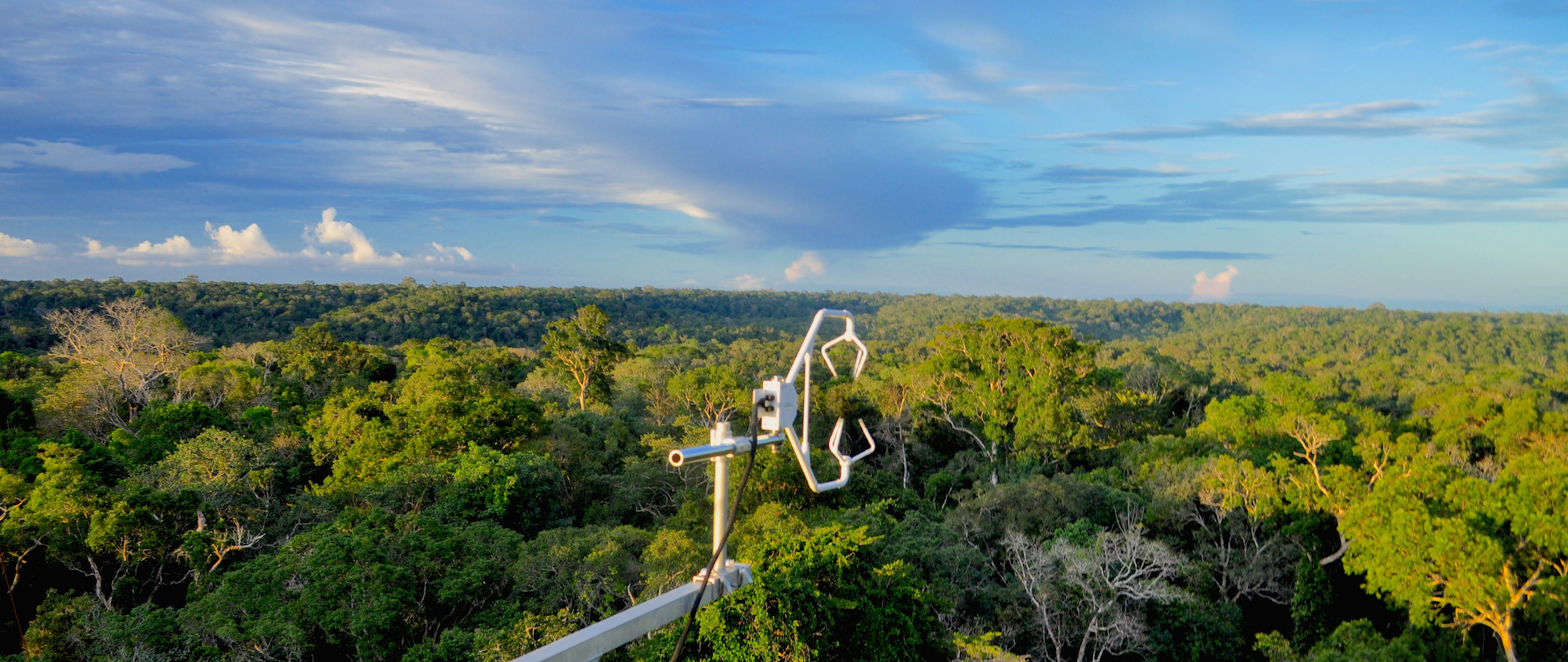
Boundary-layer turbulence measurements during the Observations and Modeling of the Green Ocean Amazon (GOAMAZON) field campaign. Picture by Marcelo Chamecki.
Understanding the effects of gentle topography on turbulent flows above forests is key to studying planetary boundary layer (PBL) dynamics and forest-atmosphere exchanges. It also has direct implications on how we interpret tower measurements and eddy-covariance fluxes. Large-eddy simulations (LES) using real topography generate overwhelming complexity in the wind fields, making it difficult to formulate general conclusions about physical processes. Idealized simulations typically use topography that are not representative of the large plateaus and narrow valleys encountered in the Amazon forest. We developed a new framework to study flow over simplified topography using LES, which is designed to capture the differences between hills and valleys. We find that while hills tend to generate elevated shear layers emanating from the hilltop that largely enhance turbulence kinetic energy (TKE) and mixing in the lower portion of the PBL, valleys produce regions of very low TKE at the top of the forest, reducing forest-atmosphere exchanges.
Impact
We have a good understanding of flow over forests sited over sinusoidal and isolated hills, but boundary layer flows respond differently to the typical topography of the Amazon (due to wide plateaus and narrow valleys). TKE reduction at the forest-atmosphere interface within valleys limits gas exchanges and can be important for the Amazon carbon and water cycles. It also has the potential to bias the eddy-covariance fluxes of gases measured at towers typically deployed on hills and plateaus, where turbulence is much stronger.
Summary
The Amazon topography is distinct from those usually studied using large-eddy simulations, and it leaves its unique signatures in the wind fields above the forest, modulating turbulence and gas transport at the forest-atmosphere interface in different ways.

Follow Us:






Keep up with the Atmospheric Observer
Updates on ARM news, events, and opportunities delivered to your inbox
ARM User Profile
ARM welcomes users from all institutions and nations. A free ARM user account is needed to access ARM data.