An official website of the United States government




A Concept of a Convection-Cloud Chamber to Study Aerosol-Cloud-Drizzle Interactions
Submitter
Shaw, Raymond A
— Michigan Technological University
Area of Research
Cloud-Aerosol-Precipitation Interactions
Journal Reference
Shaw R, M Ovchinnikov, A Sedlacek, F Yang, J Anderson, Z Bakri, G Beard, C Bois, W Cantrell, K Chandrakar, G Daniels, H Sadi, R Flagan, J Fuentes, G Gogos, G Kaufman, K Kim, P Kollias, S Krueger, E Luke, C Mazzoleni, A McComiskey, C Megaridis, A Mukhopadhyay, D Niedermeier, A Pal, I Papailias, M Rajagopal, Y Ren, G Schlaff, S Schmalfuß, J Shilling, M Shrivastava, S Singh, F Stratmann, Y Sua, L Thomas, A Wang, J Yeom, M Zawadowicz, J Zhang, Z Zheng, Z Zhu, and C Zuhlke. 2026. "A concept of a convection-cloud chamber to study aerosol-cloud-drizzle interactions." Bulletin of the American Meteorological Society, 10.1175/BAMS-D-25-0113.1. ONLINE.
Science
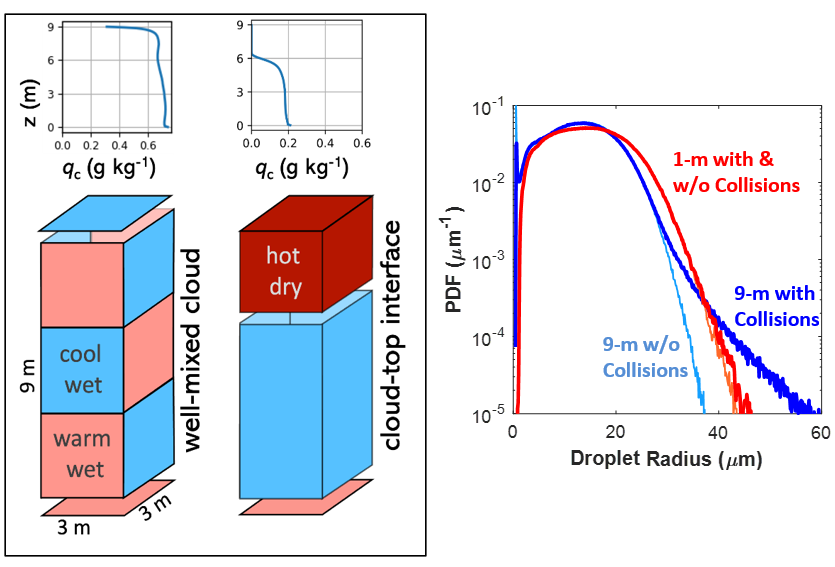
Left panel: chamber geometries, boundary conditions, and example simulated cloud water profiles for studying (i) aerosol-cloud-drizzle interactions in a well-mixed cloud and (ii) entrainment at a cloud-top interface. Right panel: modeled droplet size distributions with and without droplet collisions show little collision growth for the 1-meter chamber (red/light red) but a pronounced drizzle tail for the 9-m chamber (blue/light blue).
The Aerosol-Cloud-Drizzle Convection Chamber (ACDC2) collaboration has developed a comprehensive concept and modeling hierarchy for a convection-cloud chamber facility designed to investigate the chain of events from aerosol activation to cloud droplet growth and drizzle formation within turbulent clouds. The proposed 9-meter-tall chamber enables steady-state turbulence and microphysical conditions, facilitating continuous direct observation of cloud and aerosol properties.
Impact
By providing a controlled environment to sustain long-lifetime aerosol processing and drizzle growth, this proposed facility will overcome major observational limitations by providing a controlled, reproducible environment for studying microphysical processes. This opens a new frontier in our ability to explore the longstanding cloud-precipitation puzzle, which is a critical component for improving coarse-resolution models.
Summary
Understanding the full life cycle of processes from aerosol activation to drizzle formation in turbulent clouds remains a primary challenge in atmospheric physics. This paper introduces a detailed concept for a novel research facility featuring a 3-meter by 3-meter by 9-meter convection-cloud chamber to address this problem. The chamber's significant height is specifically designed to allow long residence time for aerosol processing and for cloud droplets to grow into drizzle through collision and coalescence.
To support the physical chamber, a suite of computational tools was developed to refine the design of the chamber and to assess the feasibility of drizzle production, aerosol processing, and cloud-top entrainment. The study also developed and tested methods for observing microphysical processes in a large-volume chamber, including novel remote sensing systems such as polarization and fluorescence spectroscopy, high-resolution lidar, and THz radar. Finally, technologies required for successfully maintaining steady cloud conditions were developed, including aerosol generation methods, and new materials for water-vapor boundary conditions.
Simulations demonstrate that the chamber can successfully sustain spatially uniform turbulence and produce substantial drizzle, promising unprecedented insights into aerosol-cloud interactions, cloud optical properties, and drizzle onset.

Follow Us:






Keep up with the Atmospheric Observer
Updates on ARM news, events, and opportunities delivered to your inbox
ARM User Profile
ARM welcomes users from all institutions and nations. A free ARM user account is needed to access ARM data.