An official website of the United States government





Turbulence Controls on Marine Shallow Cumulus Cloudiness
Submitter
Jensen, Michael — Brookhaven National Laboratory
Feng, Yan — Argonne National Laboratory
Area of Research
Vertical Velocity
Journal Reference
Ghate V, D Turner, D Mechem, J Gero, V Larson, and J Kleiss. 2026. "Turbulence and Cloudiness in Cumulus-Topped Marine Boundary Layers." Journal of Applied Meteorology and Climatology, 65(5), 10.1175/JAMC-D-25-0132.1.
Science
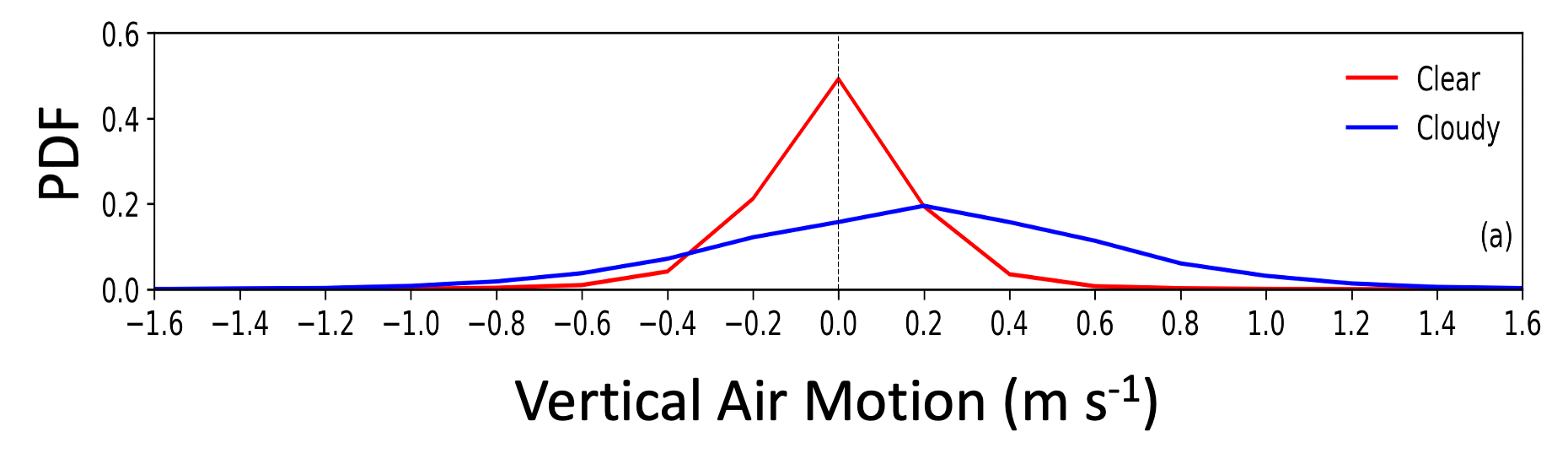
PDF of vertical air motion for clear (red) and cloudy (blue) samples at cloud-base height level during cumulus cloud conditions.
Marine shallow cumulus clouds cool the Earth by reflecting solar radiation back to space and are challenging to accurately represent in earth system models. These clouds are intimately coupled with turbulence in the boundary layer. Here, vertical air motion and its co-variability with cumulus cloudiness are characterized using data from the Atmospheric Radiation Measurement (ARM) Eastern North Atlantic (ENA) observatory.
Impact
Analysis shows cloudy updrafts contribute only ~23% to mass transport at the cloud base, highlighting the importance of clear-air eddies that exist between clouds in cumulus cloud systems.
Summary
Shallow cumulus clouds cover vast oceanic regions and are challenging to accurately represent in earth system models. Cumulus clouds result from the mass and moisture transported by turbulent eddies; hence their cloudiness is modulated by boundary-layer turbulence. In this work, the vertical air motion and cloudiness in cumulus-topped marine boundary layers are characterized using data from the ARM ENA observatory. Eight periods of cumulus clouds encompassing 141 hours and 603 clouds are analyzed. The clouds had average base heights of 558m, were 99m thick, had chord lengths of ~500m, and a mean cloud fraction of 12%. Cloudy updrafts contributed only ∼23% to the total updraft mass flux at cloud base, indicating that most vertical mass transport is carried by clear-air eddies. Updraft strength, rather than updraft fraction, predominantly controlled mass flux in both clear and cloudy regions. At the mesoscale, moist patches had greater cloudiness, updraft mass flux, and vertical velocity variance than dry patches. These results constrain cumulus parameterization development and provide a valuable observational testbed for model evaluation.

Follow Us:






Keep up with the Atmospheric Observer
Updates on ARM news, events, and opportunities delivered to your inbox
ARM User Profile
ARM welcomes users from all institutions and nations. A free ARM user account is needed to access ARM data.