An official website of the United States government





Aircraft Flux Measurements Pinpoint Where New Particles Form in the Marine Boundary Layer
Submitter
Meskhidze, Nicholas — North Carolina State University
Area of Research
Aerosol Properties
Journal Reference
Rasheeda Satheesh A, M Petters, and N Meskhidze. 2026. "Aircraft-derived particle fluxes distinguish entrainment zone and decoupled layer nucleation in marine boundary layers." Atmospheric Chemistry and Physics, 26(13), 10.5194/acp-26-9657-2026.
Science
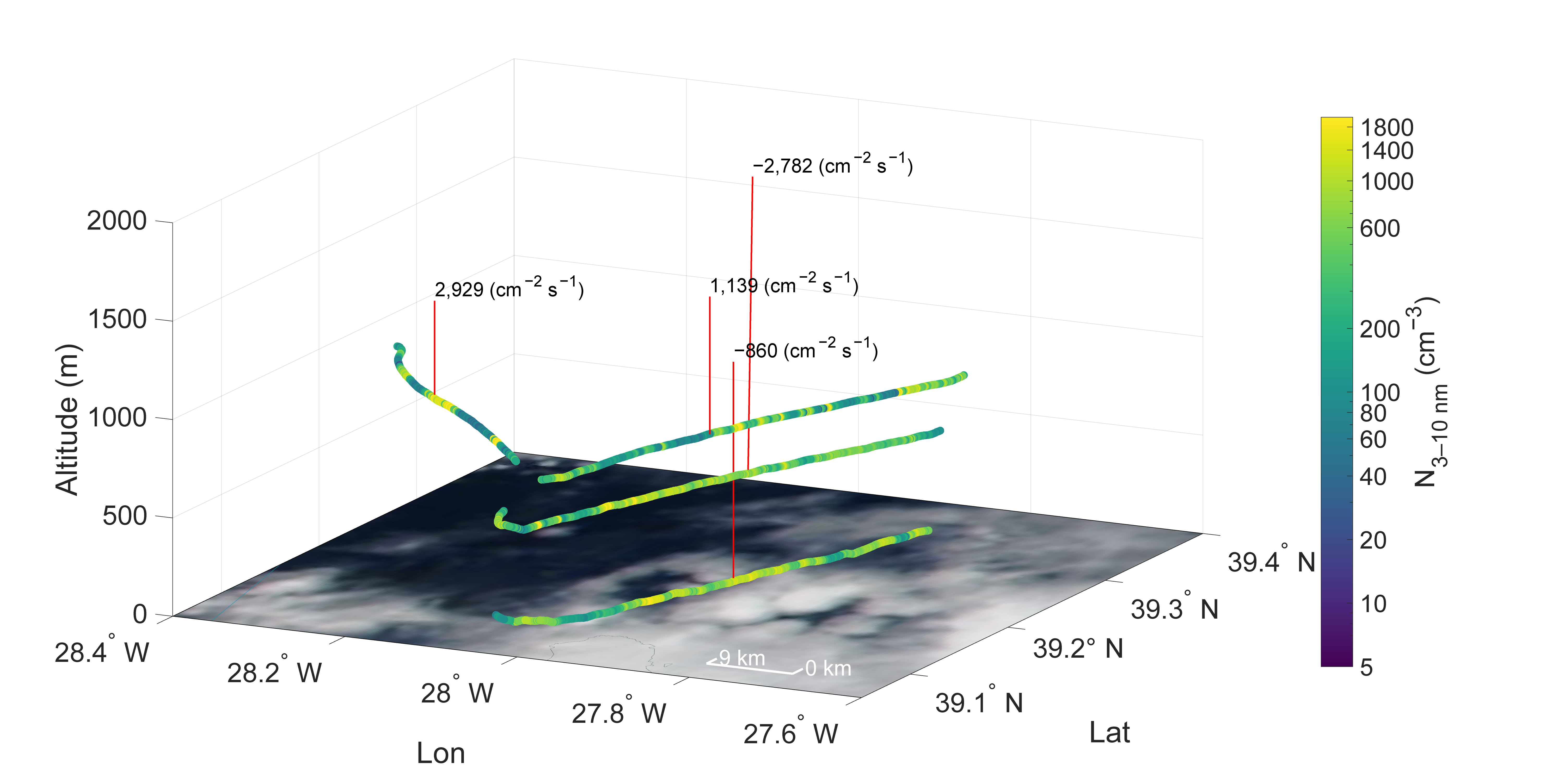
Spatial distribution of freshly nucleated (3–10 nm) particle concentrations along the G-1 aircraft flight track over the Azores, with vertical turbulent fluxes labeled at their measurement locations. Downward fluxes near the top of the boundary layer point to a nucleation source in the entrainment zone.
New aerosol particle formations within the marine boundary layer (MBL) have been difficult to pin down, limiting how well earth system models represent this aerosol source. Using measurements from the U.S. Department of Energy Atmospheric Radiation Measurement (ARM) Aerial Facility's G-1 aircraft during the Aerosol and Cloud Experiments in the Eastern North Atlantic (ACE-ENA) campaign, researchers applied a continuous wavelet transformation technique to derive vertical turbulent fluxes of freshly nucleated 3-10nm particles. This approach sidesteps the stationarity assumptions that limit traditional eddy covariance methods on a fast-moving aircraft platform, and it uses flux direction—upward versus downward—to infer whether a nucleation source lies above or below the aircraft.
Impact
The flux-based analysis identified two distinct modes of new particle formation in the remote marine boundary layer over the Azores: one in the entrainment zone near the top of the boundary layer and a second at the interface between the well-mixed surface layer and an overlying decoupled layer. In both cases, the convergence of air masses with contrasting temperature and moisture diluted existing aerosol surface area to very low levels, creating conditions favorable for nucleation. These events occurred in 15% of the flights analyzed, challenging the long-standing assumption that new particle formation is rare in marine boundary layers because of the high condensation and coagulation sink from sea spray aerosol.
Summary
Freshly nucleated particles must grow substantially before they can act as cloud condensation nuclei (CCN), and marine low clouds are especially sensitive to changes in CCN concentration. Yet direct observational evidence of where these particles originate within the MBL has been scarce, since traditional concentration measurements cannot resolve source location. This study combined two condensation particle counters and a fast integrated mobility spectrometer aboard the G-1 aircraft with high-frequency vertical wind measurements to calculate particle fluxes across six flights from the June-July 2017 and January-February 2018 ACE-ENA intensive observation periods. Strong downward fluxes—up to 41,000 particles per square centimeter per second at 1,200-1,400m altitude—indicated particle formation within a roughly 200m-thick entrainment zone at the boundary-layer top, with no free-tropospheric source detected above. A second nucleation mode occurred at the interface between the well-mixed surface layer and the overlying decoupled layer (roughly 550-800m), marked by bidirectional fluxes that spanned a far larger horizontal extent (50-60km) than the entrainment-zone events (under 10km). Both mechanisms shared a common trigger—the convergence of air masses with contrasting thermodynamic properties diluted preexisting aerosol surface area enough to favor nucleation despite the marine boundary layer's typically high condensation and coagulation sink. These results provide the first observational constraints on the vertical source location and strength of new particle formation in the remote marine boundary layer—benchmarks that can be used to evaluate and improve nucleation parameterizations in regional and global earth system models, ultimately reducing uncertainty in aerosol-cloud radiative forcing estimates.

Follow Us:






Keep up with the Atmospheric Observer
Updates on ARM news, events, and opportunities delivered to your inbox
ARM User Profile
ARM welcomes users from all institutions and nations. A free ARM user account is needed to access ARM data.