An official website of the United States government





Things Are Getting REAL Exciting at SGP!
Published: 20 January 2026
Editor’s note: ARM Instrument Operations Manager Adam Theisen provided the following post.
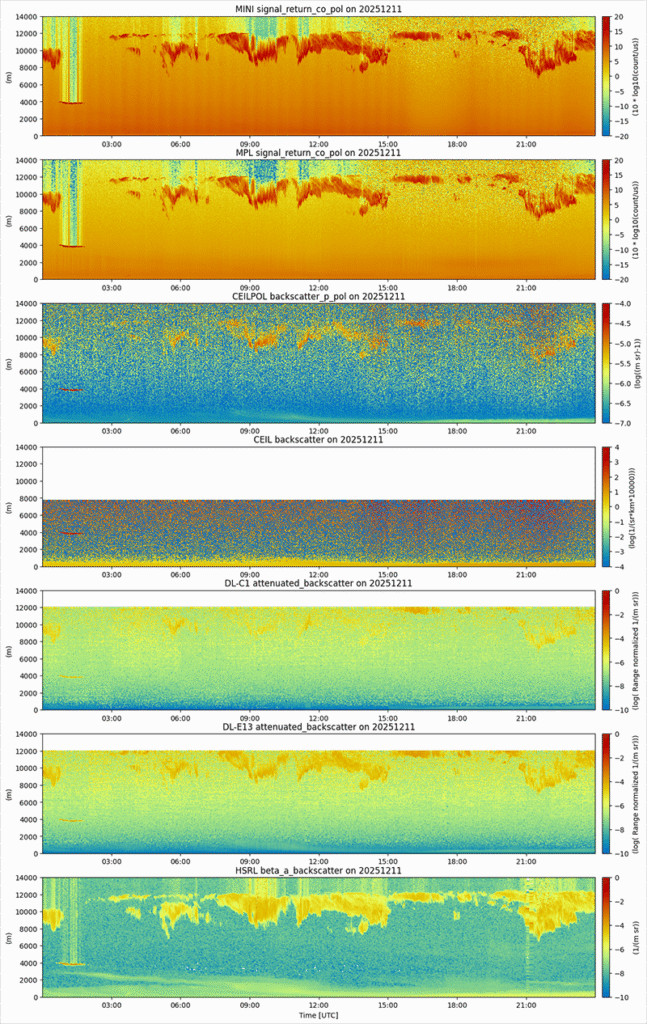
The Robust Evaluation of Atmospheric Lidars (REAL) is now underway at ARM’s Southern Great Plains (SGP) atmospheric observatory in Oklahoma to better understand how a suite of lidars perform side by side under varying atmospheric conditions. ARM operates a wide range of systems, including ceilometers, micropulse lidars (MPLs), Doppler lidars, Raman lidars, and high-spectral-resolution lidars (HSRLs). We’re also testing several new ones, such as a polarization-enabled ceilometer (CEILPOL) and an ultra-high-definition mini MPL.
With so many advanced instruments in the field, this is the right time to benchmark performance, assess consistency, and make sure we’re delivering the highest-quality measurements to the scientific community.
The two newest lidars for testing, the mini MPL and CEILPOL, have been installed and are collecting data! The HSRL has been moved from the SGP Central Facility’s optical trailer to a newly modified container. We’ll compare how these systems detect cloud bases, capture aerosol layers, retrieve water vapor, operate day versus night, and perform during challenging weather.
In addition to evaluating instruments, we want to build curated data sets and case studies that will benefit the broader research community and help guide ARM’s future lidar strategy. Data from all the existing lidar systems, including the mini MPL and CEILPOL, are currently available through ARM’s Data Discovery interface.
Discussions at the 2025 American Geophysical Union (AGU) Annual Meeting spurred a lot of interest in this intercomparison, so we want to reiterate that we’re also welcoming guest instruments, and researchers interested in participating can propose contributions through ARM’s normal field campaign process. It’s a great opportunity to collaborate, compare technologies, and advance lidar science together.

Follow Us:






Keep up with the Atmospheric Observer
Updates on ARM news, events, and opportunities delivered to your inbox
ARM User Profile
ARM welcomes users from all institutions and nations. A free ARM user account is needed to access ARM data.