An official website of the United States government





Enhanced Cloud Microphysics Data Released to Production
Published: 24 November 2025
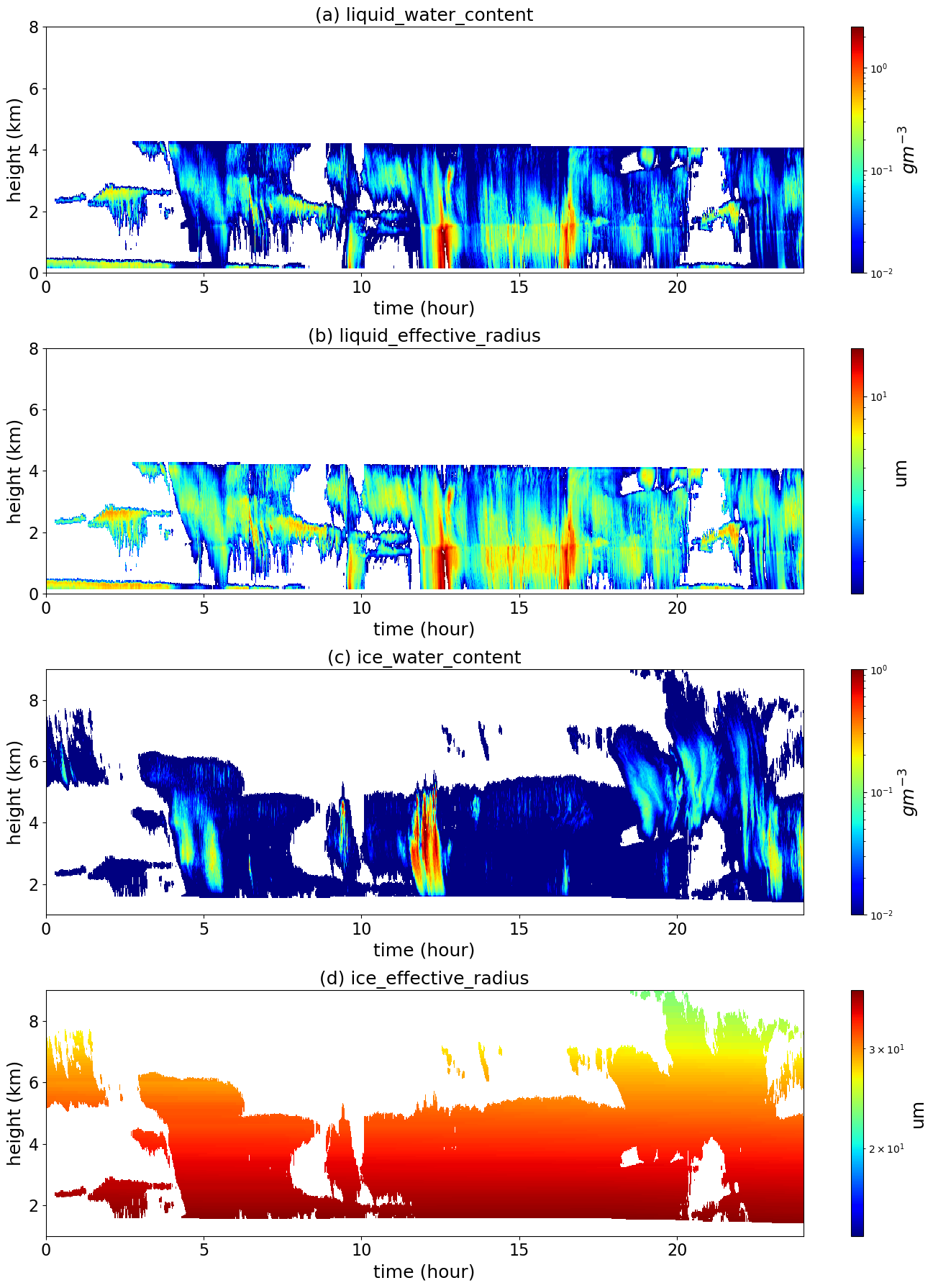
Production data are now available from the Atmospheric Radiation Measurement (ARM) User Facility’s Improved Continuous Baseline Microphysical Retrieval (MICROBASE) product with uncertainty estimation. Production or baseline value-added products (VAPs) are reviewed and verified as compliant with ARM data standards and are processed automatically or manually on ARM production servers.
MICROBASE (previously named MICROBASEKAPLUS when the product was initially released for evaluation) is designed to provide continuous, high-temporal-resolution profiles of cloud microphysical properties such as liquid/ice water content and liquid/ice effective radius. This VAP aims to support studies focusing on the process-level understanding of cloud and precipitation formation and evolution, as well as cloud particle phase partitioning and radiative heating rates. In addition, these long-term data can serve as ground truth for evaluating model performance, both for specific cases of interest and in a statistical context.
MICROBASE incorporates parameterizations from retrieval methods used in an earlier historical version of the VAP to determine liquid/ice water content and liquid/ice effective radius. In addition, the VAP introduces uncertainties to these quantities using a perturbation method developed by the Atmospheric System Research (ASR) Quantification of Uncertainty in Cloud Retrievals (QUICR) focus group (Zhao et al. 2014).
To determine the cloud microphysical properties, MICROBASE uses data from three VAPs: Ka-Band ARM Zenith Radar Active Remote Sensing of CLouds (KAZRARSCL), Interpolated Sonde (INTERPSONDE), and Microwave Radiometer Retrievals (MWRRET).
MICROBASE data are archived as daily files, with a time resolution of four seconds and vertical resolution of 30 meters, which is consistent with the KAZRARSCL data resolutions.
More information on MICROBASE, including the technical report, is available on the VAP web page.
MICROBASE production data are available for the following ARM sites and date ranges:
- the North Slope of Alaska (NSA) central facility at Utqiaġvik (formerly Barrow) from November 11, 2011, to June 30, 2014
- the Southern Great Plains (SGP) Central Facility near Lamont, Oklahoma, from January 1, 2022, to May 31, 2025
- the ARM Mobile Facility site in Gothic, Colorado, during the Surface Atmosphere Integrated Field Laboratory (SAIL) campaign from September 14, 2021, to June 15, 2023.
The current plan is to release additional SGP MICROBASE data within one month after KAZRARSCL becomes available. Additional NSA data will be processed once the calibrated KAZRARSCL product from that site becomes available.
Currently available MICROBASEKAPLUS evaluation data are expected to be reprocessed to production data and renamed as MICROBASE later in fiscal year 2026.
Ongoing work aims to integrate this VAP into the ARM Operational Ground-Based Retrieval Evaluation for Clouds (OGRE-CLOUDS) framework. The OGRE-CLOUDS team is evaluating improvements to cloud microphysics retrievals through radiative closure studies and comparisons with instrument simulator data. Through this process, the development team anticipates a continuous improvement of the cloud microphysical estimates.
Access the MICROBASE data in the ARM Data Center. (To download the data, first create an ARM account.)
Please send product-related questions or feedback to MICROBASE interim translator Scott Giangrande, OGRE-CLOUDS Principal Investigator Michael Jensen, and/or VAP developer Meng Wang.
To cite the MICROBASE data, please use doi:10.5439/1900609.
Reference: Zhao C, S Xie, X Chen, MP Jensen, and M Dunn. 2014. “Quantifying uncertainties of cloud microphysical property retrievals with a perturbation method.” Journal of Geophysical Research: Atmospheres, 119(9):5375-5385, https://doi.org/10.1002/2013JD021112

Follow Us:






Keep up with the Atmospheric Observer
Updates on ARM news, events, and opportunities delivered to your inbox
ARM User Profile
ARM welcomes users from all institutions and nations. A free ARM user account is needed to access ARM data.